
The Yellow Stain a Live Sand Dollar Leaves
Rest a dark sand dollar flat on a dry palm and wait about a minute. If yellow spreads onto your skin the animal is alive, the pigment is echinochrome, it is harmless to you, and the disc goes back into the water right side up near where you found it. The catch worth knowing before you rely on it: the test only speaks about something still dark, because a bleached white disc on dry sand lost its pigment long ago, and the absence of yellow never proves an animal is dead.
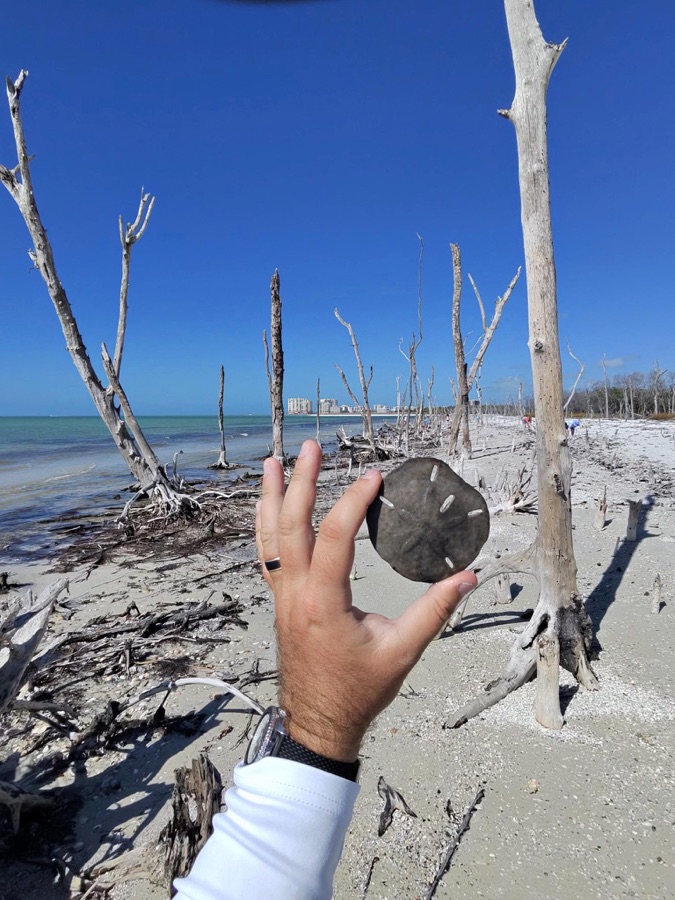
The test, in the order you actually do it
You are standing on a flat at low water and there is a dark disc in your hand. This is the whole procedure, in the order it happens.
- Look at the color. White, or anywhere near white, means you are holding the bleached skeleton of an animal that died a long time ago. Brown, purple, gray, green, or anything you would call dark: keep going.
- Look at the surface for five seconds. A living sand dollar is covered in dense short spines, and they move. Hold it steady in good light and the whole fuzzy surface shifts.
- Rest it flat on a dry palm and wait about a minute. If yellow spreads onto your skin, the animal is alive. That is the answer, and there is nothing faster or more certain you can do standing in the water.
The first two steps take about ten seconds and settle most of the discs anybody ever picks up. The third is for the ones they do not settle, and it is the reason this page exists.
The short version
- Echinochrome A is a real, documented naphthoquinone pigment, and it is harmless to handle.
- A live sand dollar stains your palm yellow within about a minute. It is the fastest live-or-dead field test there is.
- A living sand dollar is brown, purple, gray or green and covered in dense short spines that move. The white disc is the bleached test of a long-dead animal.
- The test is one-way. Yellow proves the animal is alive. No yellow proves nothing at all.
- A bleached white test on dry sand lost its pigment and its spines long before you found it, so the palm test has nothing to work with.
- Florida statute 379.101(34) counts a living echinoderm as saltwater fish and expressly excludes nonliving shells. Our house rule aboard is empty shells only.
Your captain reads the tide, picks the day's beach and helps identify what turns up.
Find these on a tourYellow means put it back, right now
If your palm goes yellow the decision is already made, and the next half minute matters more than anything else on this page.
- Put it back in the water. Not on wet sand, not on the dry beach, and not in a bucket while you finish looking around.
- Right side up. The five-petal figure goes up. The mouth, a small central opening, goes down against the bottom. The anatomy page shows both faces if you cannot tell which is which.
- Near where it came from, at about the same depth, on the same soft bottom. It was where it was for a reason.
- Set it down. Do not throw it. The skeleton is roughly a millimeter thick and brittle, and the animal inside is not improved by the landing.
- Then leave it alone. Do not pass it around the group first. The yellow on your hand is what being out of the water looks like from the animal's side.
Wash your hands whenever it suits you. The pigment is harmless and there is no hurry about it.
What the yellow actually is
The pigment is echinochrome A. It is a real, documented compound, a naphthoquinone, and it belongs to a family of pigments echinoderms have been carrying for a very long time. The name is not invented for a label: echino is the same root as in Echinoidea, the class that holds sea urchins and sand dollars.
Pigments of this family are a large part of why a living echinoid has any color at all. A sand dollar worked into the top layer of sand is brown or purple or a dull green. A sea urchin in a crevice is often deep red or near black. The white disc on a gift shop shelf is what is left when the tissue, the spines and the pigment are all gone: a bare, plated, sun-bleached skeleton properly called a test.
So the yellow on your palm is not dirt, not algae, and not something the animal picked up off the bottom. It is the animal.
Why a live one leaves it on your skin
Echinochrome is not a coat of paint on the outside. It is in the tissue and in the fluid inside the animal, which is why a living sand dollar is colored all the way through and a dead one fades from the outside in.
Lift one out of the water and several things happen at once that never happen to it on the bottom. It is in air. It is carrying its own weight instead of being held up by water. It is against a warm dry surface that pulls moisture out of it. And it is being squeezed, which is a pressure a buried animal has no experience of. Fluid comes out of the tissue, and the pigment comes with it.
Exactly how much comes out, how fast, and by what route is not something we have seen measured for our Gulf animals, and we are not going to pretend otherwise. What is not in doubt is that it happens, reliably, and quickly enough to be useful while you are still standing where you found it.
There is a second thing worth taking from that. The stain is a stressed animal doing something it would rather not be doing. Run the test once, take your answer, and put it back.
It is harmless, and here is what harmless means
Echinochrome is harmless to handle. It is not caustic, it is not a venom, and a sand dollar has no sting, no bite you can feel, and no defense that reaches you at all. You do not need gloves and you do not need to scrub.
Parents ask about this every season, usually while holding a child's yellow hand out at arm's length. The honest answer is that the stain is the least interesting thing in the situation. It comes off skin with ordinary washing and it fades with the normal wear of a hand.
We are deliberately not giving you a number of hours, and you should distrust any page that does. How long a mark lingers depends on how much pigment transferred, how long the animal sat in the hand, and whose skin it landed on, and nobody we can point to has published a figure for it. What we can tell you from a lot of seasons on the water is that it behaves like a pigment on skin rather than a dye on cloth. If you are about to pick up a white towel, rinse first.
One sentence about the research, and then we stop
Echinochrome A has attracted research interest outside marine biology for its chemistry.
That sentence is the entire claim this page makes about it, and the restraint is deliberate. We run a shelling charter out of Goodland. Anything past that line would be a claim about health or medicine, we are not qualified to make one, and neither is any other shelling website. If the chemistry interests you, read the primary literature, not a page about boat trips.
The signals that travel with the stain
The stain almost never arrives alone. By the time your palm goes yellow, four or five other things have already been telling you the same thing. Learning them is what turns a one-minute test into a two-second glance.
- Color. A living sand dollar is brown, purple, gray or green. Never white. This is the strongest signal on the list and it costs nothing.
- Spines that move. The surface of a living one is a dense mat of short movable spines, and the movement is the giveaway. A bare test has none, and the surface underneath is smooth and finely pitted. How a sand dollar moves covers what those spines are doing when nobody is staring at them.
- Texture. A living one feels velvety and faintly grippy, and it is damp all the way through. A bare test feels like chalk.
- The underside. Turn it over. A living one has soft tissue over the mouth and the food grooves, often with tube feet working. A dead test has open grooves and a clean central hole.
- Weight. A living one is heavy for its size, because the space inside is full of tissue and water rather than air. Treat this as the weakest signal here: a long-dead test packed with beach sand is heavy too.
- Smell. Crude, and it points the other way. A strong sour smell means something died and has begun to break down. That is a reason to set it down, not a reason to pocket it.
The honest limit: it only speaks about something still dark
This is where most versions of this advice go wrong. The palm test is not a test for death. It is a test for life, and those are not the same thing.
A white sand dollar lying on dry sand above the tide line has been dead long enough to lose its tissue, its spines and its pigment. Running a palm test on it tells you nothing, because there is nothing left in it to come out. People do it anyway, get no yellow, and conclude that the test confirmed the animal was dead. It did not. The color had already answered the question, and the palm added exactly nothing.
So the rule runs one way only. Yellow means alive. No yellow means you have not learned anything. Everything you truly know about a white disc on dry sand, you knew from looking at it.
That is also why this page keeps saying the word dark. The test has a domain. Inside it the test is excellent. Outside it, the test is theater.
How the test fails
Four ways, and it is worth knowing all four because they push in the same direction.
- Recently dead, still dark. An animal that died a day or two ago can still be dark and still hold most of its spines, and it may give you little or nothing. This is the failure that matters.
- Wet hands. A palm running with seawater carries the pigment off as fast as it arrives. Dry your hand on a shirt first. On our boat this is easily the commonest reason somebody reports no stain from an animal that is plainly alive.
- Too brief a contact. A two second touch is not the test. The test is holding it flat and still, on dry skin, for about a minute.
- A barrier. Gloves, thick sunscreen, or a hand caked in wet sand all sit between the animal and your skin.
Notice that every one of those produces the same kind of error: an animal that is alive, testing as though it might not be. There is no realistic way for a bare white test to fake a yellow stain. That asymmetry is what decides your next move.
What to do when you are not sure
Put it back.
That is not a hedge, it is arithmetic. Weigh the two mistakes against each other. Take home a dark disc that turns out to have been alive and you have killed an animal, carried a decomposing one into your car, and taken a living echinoderm, which Florida law does not treat the same way it treats picking up an empty test. Put back a dark disc that turns out to have been empty and you have lost a keepsake and nothing else.
The two errors are not the same size, and they never will be. When color, spines and stain disagree, or when you simply cannot tell, the answer is the water.
There is a shortcut worth saying plainly to anyone with kids in the group. The white ones up on the dry sand are the ones you want anyway: already clean, already bleached, and nothing had to die for them. The dark one at the waterline is the one to look at, photograph, and leave where it is.
Why we run empty shells only, whatever the palm says
Our rule aboard is short and it is ours: empty shells only. It holds whether or not anybody ran a palm test, and it covers sand dollars, whelks, conchs, urchins and anything else that might still have an animal in it.
The legal picture behind it is worth knowing. Florida statute 379.101(34) defines "saltwater fish" to include living mollusks and echinoderms, and expressly excludes nonliving shells. That single sentence is the whole difference. A live sand dollar is an animal you would need a Florida recreational saltwater fishing license to take. An empty test is a piece of calcium carbonate and needs nothing. On City of Marco Island beaches live shelling is separately prohibited by city code section 54-36(o), and section 54-36(k) bans removing sand from the beach.
Several places we run sit inside protected areas with their own rules, some of which appear stricter than empty shells only. Shell collecting is prohibited outright in Everglades National Park and in Ten Thousand Islands National Wildlife Refuge, and Florida State Parks prohibit removing shells, sand, rocks or marine animals from any park area. We keep one rule aboard rather than a map of exceptions, because one rule is what people actually remember at the rail.
How many you may take is a genuinely open question
You will find pages that hand you a number. We are not going to, because we could not verify one.
Two independent legal reviews of Florida's rules, run on exactly this question, reached different conclusions about whether a numeric collecting limit applies to sand dollars. That is not a disagreement a website should paper over with a confident sentence. We have put the question to the Florida Fish and Wildlife Conservation Commission in writing, and until an answer comes back we will not publish a figure.
Read the rules yourself on FWC's recreational sea shell collecting page. While you are there, note the nearby claim that is not in dispute at all: "two live shells per species per person, four per vessel" is not Florida law. It traces to a Lee County ordinance repealed in 2002, and it has been copied forward ever since.
None of which is a problem for anybody following the simple version. Empty shells only, and take conservatively.
Not every dark disc is a sand dollar
The palm test works on more than one animal, which is a feature rather than a fault. It answers "is this alive", not "what is this". Pigments of this family are widespread across echinoids, so a dark, fuzzy, living echinoid of almost any kind is a poor candidate for a pocket.
Sea biscuits catch people out most often. Clypeaster subdepressus and Clypeaster rosaceus are thick and domed rather than flat, they get called giant sand dollars constantly, and they are not sand dollars at all, though they sit in the same order. The notched sand dollars of the genus Encope are heavier and thicker than the five-slotted animal most people picture. Dark plus fuzzy plus yellow means the same thing on every one of them, and calls for the same response.
Watch the ground while you decide, too. Sand dollars live in dense aggregations on sandy bottoms, at densities that reach hundreds per square meter in some populations, so a living one at your feet is fair warning that you are standing at the edge of a bed. That is not something to walk through.
Out here
This is the first thing we teach on a landing, before anybody has found anything, because it is the one piece of information that changes an outcome rather than just filling time. Dark and fuzzy: leave it. White and chalky: it is yours. Not sure: rest it flat on a dry palm for about a minute, and if your hand goes yellow, walk it back to the water and set it down petals up.
If you want the rest of the animal, the full sand dollar overview covers what it is and how it lives, and the sand dollar codex takes it species by species and part by part. If you would rather learn it with one in your hand, trips run three times a day out of San Marco Marina in Goodland and you can reserve a seat.
Questions people actually ask
Is the yellow stain from a sand dollar dangerous?
No. The pigment is echinochrome, a naphthoquinone, and it is harmless to handle. A sand dollar has no sting, no venom and no bite that reaches you, so there is nothing to treat and no reason for gloves. Wash your hands when it suits you. The only thing the yellow should worry you about is the animal, which is alive and needs to go back in the water.
What does it mean if a sand dollar does not stain my hand?
Less than people assume. The test runs one way: yellow proves the animal is alive, but no yellow proves nothing. A recently dead animal can still be dark and still have spines and give you nothing. So can a live one held with wet hands, touched for two seconds, or handled through sunscreen or gloves. Every way this test fails makes a live animal look dead, so when in doubt, put it back.
How long does a sand dollar stain stay on your skin?
We will not give you a number and you should distrust anyone who does. It comes off with ordinary washing and fades with the normal wear of a hand, but how long a mark lingers depends on how much pigment transferred, how long you held the animal, and whose skin it landed on. Nobody we can point to has published a figure. In practice it behaves like a pigment on skin, not like a dye on cloth.
What should I do with a sand dollar that turns out to be alive?
Put it back in the water, not on wet sand and not on the dry beach. Set it down right side up, five-petal figure facing up and the mouth against the bottom, at about the depth and on the kind of soft bottom you found it on. Set it, do not throw it: the skeleton is about a millimeter thick and brittle. Then stop handling it and let it work its way back in.
Does the palm test work on a white sand dollar?
No, and it does not need to. A white disc has been dead long enough to lose its tissue, its spines and its pigment, so there is nothing left in it to stain anything. The color already told you what you needed to know. The test only has anything to say about something still dark: brown, purple, gray or green. Outside that range it is not a test, it is a ritual.
Is it illegal to take a live sand dollar in Florida?
Florida statute 379.101(34) defines saltwater fish to include living echinoderms and expressly excludes nonliving shells, so taking a live one is taking saltwater fish and requires a Florida recreational saltwater fishing license, while an empty test requires nothing. On City of Marco Island beaches live shelling is separately banned under city code section 54-36(o). Whether a numeric limit applies is genuinely unsettled, so check FWC. Our rule aboard is empty shells only.
Why is a living sand dollar dark instead of white?
Because the animal is still in it. A living sand dollar is covered in skin and a dense mat of short movable spines, and echinochrome and related pigments run through the tissue underneath, which is why they come off on your palm. The familiar white disc is the test, an internal skeleton of fused plates, after the tissue, spines and pigment are gone and sun and surf have bleached what remains.
Where this comes from
Every factual claim on this page traces to a published source. Where the science or the law is genuinely unsettled, we say so on the page rather than pick the tidier answer.
Come find them with us
Three trips a day out of Goodland, into water the road does not reach. Captain-led, family-friendly, and timed to the tide.