
The Six-Holed Keyhole Urchin
Count the openings pierced clean through the disc. Five means the genus Mellita. Six means Leodia sexiesperforata, the six-holed keyhole urchin, which ranges North Carolina to Uruguay and includes Florida and the Gulf of Mexico. It is the cleanest identification a sand dollar offers, with one condition attached: the count only works on a test whose margin is complete, because a broken disc can lose a slot and read as the wrong animal.
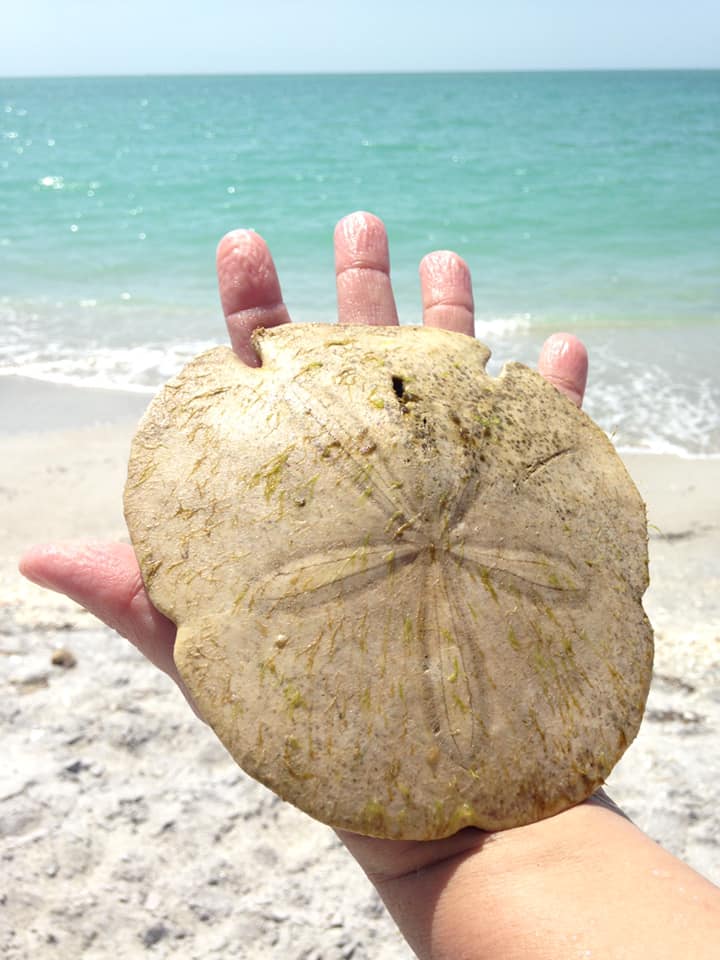
Count the Slots. That Settles It.
Hold the disc up to the light and count the openings that go all the way through it. Five means one animal. Six means another. There is no judgment call, no shading between two answers, no holding your specimen next to a photograph and hoping.
Five enclosed slots is the genus Mellita, and which Mellita is a longer argument that has its own page. Six is Leodia sexiesperforata, the six-holed keyhole urchin. A different genus, not a variant, not an unusual Mellita that grew an extra hole.
The slots have a proper name: they are lunules. They form as the animal grows, so they are structure rather than damage, which is the first thing most people get wrong about them. Our anatomy page names every part of a bare test, lunules included. This page is about what the count buys you, which turns out to be more than almost anything else a beach hands over.
The short version
- Six lunules, the slots pierced clean through the test, means Leodia sexiesperforata, the six-holed keyhole urchin. Five means the genus Mellita.
- The World Register of Marine Species carries Leodia sexiesperforata under AphiaID 422502.
- Its range runs North Carolina to Uruguay, Florida and the Gulf of Mexico included, so it overlaps the five-slotted Mellita here. On this coast, range cannot separate the two. The count can.
- Sexies is Latin for six times and perforata means pierced. The epithet is literally a hole count, built the same way as quinquiesperforata on the Atlantic five-slotted species.
- We have not verified how often this animal turns up on this coast compared with the five-slotted one, so we do not call it common and we do not call it rare.
- A broken test can drop a six to a five, or open a lunule out to the rim so it imitates the notch of an Encope. Count only on a disc with its full margin intact.
Your captain reads the tide, picks the day's beach and helps identify what turns up.
Find these on a tourLeodia sexiesperforata, and What the Name Says
Read the epithet and it hands the identification back. Sexies is Latin for six times. Perforata is pierced. Six times pierced. The animal is named for the thing you just counted.
That pattern is not a coincidence of one name. The Atlantic five-slotted species is Mellita quinquiesperforata: quinquies, five times, pierced. Eighteenth century naturalists were counting the holes too, and they built the count into the names.
The genus name Leodia we are not going to explain, because we have not verified where it comes from, and a plausible-sounding guess at a Latin root is exactly the sort of thing that gets copied around until it looks like a fact.
The World Register of Marine Species carries the species under AphiaID 422502. That record, not this page, is where to read the naming authority, the year and the names the species has carried before. If you meet it in an older book under a different genus, that is ordinary name history rather than anyone's error.
Why Counting Works When Almost Nothing Else Does
Most shell identification is a matter of degree, and degrees are where people lose their footing. Color is among the least reliable identifiers there is: coquina is a single species that occurs in an enormous range of colors and patterns. Size tells you how far an animal got, not what it was. Outline gets rounded off by the surf, and surface texture wears away entirely.
The characters that survive contact with a real beach are the ones you can count. Rib counts on a bivalve. Hinge teeth. Small whole numbers, fixed by how the animal is built, that do not blur into each other. Our Florida identification guide is organized around that idea: start from what the eye can actually see.
Lunule count is the cleanest example this coast has. A small integer, structural rather than superficial, readable from the top face, from the underside, or by holding the disc against the sky. It does not fade, does not depend on the light you are standing in, and does not need a reference specimen alongside it.
Where the Sixth Slot Sits
Orient the disc first. Turn it over. The mouth, the peristome, is the opening at the center of the underside. Then look toward the rim on that same face for a second, much smaller opening: the periproct, the anal opening, which sits near the margin rather than on top where people expect it. The edge nearest the periproct is the animal's back.
With the back settled, the arrangement reads. One lunule sits on the midline between the center and that back edge. Both Mellita and Leodia carry it, and it is usually the odd one out: longer, narrower, running front to back rather than radiating.
The others line up with the arms of the petalodium on the upper face, and this is where the two animals part company. A five-slotted Mellita has slots at four of the five petals and none at the front one, so the front of the disc is unpierced and the spacing around the rim is visibly uneven. A six-slotted Leodia carries one at the front petal too, so the openings spread around the disc more evenly.
Check that against the specimen in your hand rather than taking it from us. If the geometry looks odd, the count still governs. Arrangement is corroboration, not the test.
What the Count Is Really Telling You
Six versus five is a bigger result than one extra hole. It is a different genus. Leodia and Mellita are separate branches inside the same order, Clypeasteroida, the order that also holds the sea biscuits. So the disc in your hand is not a Mellita with a spare opening. It is an animal that was never going to have five.
Past the count and the geometry that goes with it, be careful what you claim. The characters a specialist works from live in plate architecture, in the fine structure of the food grooves, and generally in fresh material rather than beach-cast tests. On a bleached disc off the wrack line, the honest list available to a non-specialist is short: the count, where the openings sit, and whether the outline is entire.
What will not separate them is most of what people reach for first: not color, since both end up white, not size, since both grow continuously, and, as the next section says, not range either.
Range: North Carolina to Uruguay
Leodia sexiesperforata ranges North Carolina to Uruguay, and that range includes Florida and the Gulf of Mexico. This is a warm-water animal whose distribution sweeps the western Atlantic from the Carolinas down through the Caribbean and along the coast of South America.
Now set it beside the five-slotted animals. Mellita tenuis, the Gulf species, runs Louisiana to west Florida. Mellita quinquiesperforata, the Atlantic one, runs Virginia to Brazil. Southwest Florida sits inside the Leodia range and inside the Mellita tenuis range at the same time.
That matters more than it sounds. On the Mellita page, range is the strongest single piece of evidence a beachcomber has, because it separates the Gulf species from the Atlantic one when the worn test itself will not. Here it does the opposite. Both animals belong here, a distribution map cannot tell you which one you are holding, and anyone reasoning you toward one is reasoning from geography instead of your specimen. Which is exactly why the count is worth so much on this particular stretch of water.
How Often It Turns Up Here Is Something We Have Not Checked
Here is the gap, stated plainly, because covering it would be worse than having it.
We do not know how often Leodia sexiesperforata turns up on this coast compared with the five-slotted animal. We have not verified a published figure for relative abundance here, and we have not run systematic counts of our own that would let us give you one. So we are not going to call it common and we are not going to call it rare. Either one would be a guess wearing the clothes of information.
Think about what each guess would cost you. Told it is rare, you stop counting, because you already know what you are going to find. Told it is common, you write the six-slotted name on a five-slotted disc because it matches what you expected. An unverified frequency does not sit there harmlessly. It changes what people see.
There is a second problem underneath the first, and it would still be there if someone handed you a number tomorrow. What washes up is not a census of what lives out there. A test about a millimeter thick breaks in the surf. Currents sort material long before it reaches dry sand. Mechanical beach raking removes shell along with wrack, and Collier County does groom Marco Island beaches. A person walking a wrack line notices what catches the eye. Beach-cast counts measure the beach at least as much as the population.
What would close the gap is not anybody's opinion. It is records: counts, with dates and localities, kept by people who were actually looking.
What the Slots Are Actually For
Unsettled, and a six-slotted animal does not settle it.
Two explanations are in circulation and both are serious. The hydrodynamic one: a flat disc in moving water generates lift the way a wing does, and a wing with holes in it generates less of it, so the lunules are how the animal keeps from being picked up and rolled along the bottom. The feeding one: the slots work with the food grooves on the underside as part of the plumbing that moves fine particles toward the mouth at the center.
Those are not mutually exclusive. A structure is allowed to do two jobs, and both accounts sit as comfortably on an animal with six openings as on one with five. Pages that state one flatly, as settled, have gone further than the work does.
What the slots are not is wounds. There is an old legend that reads the openings in a sand dollar as the wounds of the crucifixion. Its authorship is genuinely unknown, so we describe it rather than reproduce it. And notice that the story only counts to five. Hold a Leodia and it has an extra hole in it.
Where It Lives, and What a Bed Is
Sand, and specifically the top layer of it. A sand dollar works itself down into the surface of a sandy bottom rather than crawling around on top of it, moved by spines and tube feet together, and it can sit edge-on into a current rather than face it flat. How that machinery works is the subject of our how they move page.
Depth varies by species, from shallow water out to considerable depth. And these are not scattered individuals. Sand dollars live in dense aggregations, and in some populations those beds reach densities of hundreds per square meter. That is normal for the animal rather than a freak concentration, so a bare test on the beach came from a crowd, somewhere out there. The sand dollar beds page goes into how those work.
Which sets the only etiquette that matters. Standing over a bed means standing over a great many live animals whose entire skeleton is about a millimeter thick, and a bed is not something to walk through. Aboard our boat the rule is empty shells only, and that is our own house rule.
Size, and Why There Is No Number Here
We are not giving you a size range for Leodia sexiesperforata, because we have not verified one against a primary source. An invented measurement is precisely what this page exists to argue against, and a size range is unusually easy to invent because almost nobody checks one.
What can be said without measuring anything: a sand dollar grows continuously, so the disc in your hand is telling you roughly how far that individual got, not which species it belonged to. A young one is a small version of the same shape, not a different shape. Which means size cannot separate a Leodia from a Mellita even in principle: the two overlap wherever the young of one meet the adults of the other.
If you want a number, measure your specimen and write down what you measured. That is data. A range copied off a page that copied it off another page is not, and it never becomes data by being repeated.
When the Count Fails
The count is the best character the beach offers and it has one failure mode: damage. Knowing it is the difference between a careful record and a confident wrong one. Three versions to watch for.
- A missing piece drops the count. Break a chunk out of the margin of a six-slotted test and it can read as a five-slotted one. This is the dangerous direction, because five is a real answer and nothing about it looks wrong.
- A slot can open out to the rim. A lunule near the margin, with worn or cracked test between it and the edge, can break through and become a notch in the outline. Notches at the rim are the character of Encope, the notched sand dollars, so a broken disc can imitate a different genus entirely. Look closely at the edges of the opening. A fresh break is ragged and often paler, where an Encope notch is part of an intact, finished margin.
- Wear widens and rounds. Sand works at the edges of a lunule the way it works at everything else, and a long-tumbled test is a soft version of itself.
So the rule costs nothing. Count only on a disc whose margin is complete the whole way around. If a piece is missing, the count is not available on that specimen, and the honest move is to write that down instead of a name. Tests this thin break easily, which is a subject in itself on our why they break page.
How to Record a Six-Slotted Find
A count of six on an entire test is a better result than most beachcombers ever get. On the Mellita page we had to tell you that a worn test usually cannot be taken to species by eye, because two Mellita species look alike once the color is gone. Here the character that gets you to the genus is the same character the species is named for. So write it down, and write down how you got there.
- Leodia sexiesperforata, determined on a lunule count of six, test entire. A name with its method attached, which lets anyone reading the label later check your reasoning instead of trusting it.
- Sand dollar, count not available, margin incomplete. The correct entry for a broken disc. Not a failure, just an accurate record of what the specimen could support.
- Cf., short for the Latin confer, compare, records that you leaned one way without settling it.
Around the name, record what you observed rather than what you concluded: the date, the beach and the most specific position you can give, whether the animal was alive or already a bare test, the count you made, and whether the disc was whole. Photograph both faces before it breaks, because eventually it will, and put the photograph on iNaturalist if you want another set of eyes on it. A specimen without a label is a decoration and a specimen with one is data, which is the argument our shell collecting page is built on. Kept over time, those records are also the only thing that would ever answer the question this page had to leave open.
How to Check the Name Yourself
One trap first, because it catches careful people. MolluscaBase is the accepted authority for mollusk names and the right tool for a whelk, a conch or a cockle. It does not cover sand dollars. A sand dollar is not a mollusk but an echinoderm, phylum Echinodermata, class Echinoidea, and MolluscaBase is mollusk-specific by design. An empty search there means you reached for the wrong register, not that the name is wrong.
The one you want is the wider World Register of Marine Species, of which MolluscaBase is one part. Search the name, then read the record rather than the headline: the status, accepted or unaccepted with a pointer to whatever replaced it; the AphiaID, 422502 here, which holds still even when names move; the authority and year; and the distribution, which puts an animal on your coast or takes it off. For specimens rather than names, the Florida Museum's invertebrate zoology collection is the regional reference, and for the animal rather than its name, start at the sand dollar codex.
If you would rather ask a person than a database, that is what the ride back is for. We run three trips a day out of San Marco Marina in Goodland, and you can reserve a seat here.
Questions people actually ask
How do I tell a six-holed keyhole urchin from an ordinary sand dollar?
Count the openings that go all the way through the disc. Six enclosed slots, called lunules, means Leodia sexiesperforata. Five means the genus Mellita. Notches cut into the rim instead of enclosed slots means Encope. No openings at all on a thick domed body means a sea biscuit, genus Clypeaster. The count is the identification, and it works from either face.
Is Leodia sexiesperforata rare on Southwest Florida beaches?
We do not know, and we would rather say so. We have not verified a figure for how often it turns up here compared with the five-slotted animal, and we have not run counts of our own, so we will not describe it as common or as rare. Both are in range on this coast. Count your finds and record them, and you will have better information than we can give you.
Where is the sixth slot compared with the other five?
Find the back of the animal first: turn it over and look for the small periproct opening near the margin on the underside. One lunule runs along the midline between the center and that back edge, and both genera have it. The rest line up with the petals. A five-slotted Mellita leaves the front petal without one, so the front of the disc is unpierced. A Leodia carries one there too.
My sand dollar has five slots but one is broken open to the edge. What is it?
Treat the count as unavailable. A lunule near the margin can break through to the rim, and a missing chunk of margin can remove a slot entirely, so a damaged six-slotted test can read as five, or as a notched Encope. Look at the opening's edges: a fresh break is ragged and often paler than the worn surface around it. If the outline is not entire, record the damage rather than a name.
Does the six-holed keyhole urchin occur in the Gulf of Mexico?
Yes. Its range runs North Carolina to Uruguay, and that includes Florida and the Gulf. Note what this does to your reasoning. The five-slotted Mellita tenuis is also a Gulf animal, Louisiana to west Florida, so both are in range on this coast at once. Geography cannot settle which one you are holding here. The lunule count can, and that is what makes it worth making.
What does sexiesperforata mean?
Six times pierced. Sexies is Latin for six times and perforata means pierced, so the species epithet is a hole count. The Atlantic five-slotted species is built the same way: quinquiesperforata, five times pierced. Both names come out of a tradition of naming these animals for the openings through the test, which is why this corner of sand dollar naming is unusually easy to keep straight.
What are the lunules for?
That is genuinely unsettled, and a six-slotted animal does not resolve it. One explanation is hydrodynamic: a flat disc in moving water generates lift, and holes through it reduce that lift so the animal is harder to pick up and roll. Another is about feeding, with the slots working alongside the food grooves that carry fine particles to the mouth. Both are taken seriously. Neither is established.
Where this comes from
Every factual claim on this page traces to a published source. Where the science or the law is genuinely unsettled, we say so on the page rather than pick the tidier answer.
Come find them with us
Three trips a day out of Goodland, into water the road does not reach. Captain-led, family-friendly, and timed to the tide.