Encope: The Notched Sand Dollars
Encope is the genus of notched sand dollars: cut into at the rim rather than pierced by the clean enclosed slots that run through a Mellita, and noticeably heavier and thicker in the hand. The species a Florida beachcomber meets is Encope michelini, whose US Fish and Wildlife Service common name is the Notched Sand Dollar, occurring on both Florida coasts and Gulf-wide. The two names the shell trade hangs on it, "inflated" and "arrowhead", are both wrong, and the useful skill this page teaches is telling a real notch from a broken lunule on a worn test.
What Encope Is
Encope is a genus. Not a species, not a common name: a genus, holding the sand dollars that are cut into at the rim.
The addresses above it run like this. Phylum Echinodermata. Class Echinoidea, which is the sea urchins. Inside Echinoidea, the irregular urchins: flattened, with a front and a back, rather than a globe with no such axis. The order is Clypeasteroida, and it also holds Mellita, the five-slotted sand dollars, and Clypeaster, the sea biscuits. Encope is a third address in the same neighborhood, and it is the one most people have never been told about.
There are several species in the genus. On a Florida beach the one worth knowing by name is Encope michelini.
The short version
- Encope is a genus of sand dollars notched at the rim rather than pierced by clean enclosed slots, with a test that is heavier and thicker than a Mellita's.
- The US Fish and Wildlife Service common name for Encope michelini is the Notched Sand Dollar. It occurs on both Florida coasts and Gulf-wide.
- "Inflated" is not an Encope name. FWC uses it for the inflated sea biscuit, Clypeaster rosaceus, which is not a sand dollar at all.
- "Arrowhead sand dollar" is a vendor nickname applied inconsistently across several Encope species. It has no register entry and no type specimen behind it.
- A lunule is enclosed by test on every side. A notch breaks the outline of the disc. On a worn specimen the difference is in the finish of the edge, not the shape of the opening.
- Sand dollars are echinoderms, so MolluscaBase does not cover them. Encope names live in the wider World Register of Marine Species.
Your captain reads the tide, picks the day's beach and helps identify what turns up.
Find these on a tourNotched at the Rim, Not Slotted Through the Test
Two words carry this page, so get them straight first.
A lunule is an opening that passes through the test and is enclosed by test on every side, the way a buttonhole is enclosed by cloth. A notch is an indentation cut in from the margin, open to the outside, the way a bite is taken out of a cookie.
A Mellita is built with lunules: the outline of the disc is an unbroken curve and the slots sit inside it. An Encope is built with notches, so the outline itself turns inward, runs around the opening and comes back out to the rim. That is a difference in how the animal is built, not in how much surf it has seen.
The second difference you feel rather than see. An Encope is heavier and thicker. A Mellita test is roughly a millimeter of fused plate and handles like a wafer; an Encope has substance to it. For the five-slotted animal in full, including why the Gulf one is Mellita tenuis and not the Atlantic name nearly every source prints, see our Mellita page. For the parts of either animal named one at a time, our anatomy page.
Encope michelini and the Notched Sand Dollar
Encope michelini is the species a Florida beachcomber is most likely to meet, and the one carrying a common name with an institution behind it. The US Fish and Wildlife Service lists its common name as the Notched Sand Dollar. That name is descriptive, it is accurate, and unlike most sand dollar vernacular you can follow it back to a body that publishes lists.
It occurs on both Florida coasts and Gulf-wide. That is wider than people expect, and it changes how much work locality can do. With a five-slotted disc, range is a real argument, because the Gulf species and the Atlantic species live on opposite sides of the state. With a notched disc that argument is not available.
What that buys you is discipline. If the map cannot narrow it, the specimen has to.
How to Tell a Notch From a Lunule on a Worn Test
This is the part worth carrying to the beach, because the definition above stops being tidy once a test has spent a season in the surf.
Start with the wrong method so you can stop using it. Holding the disc up to the light settles nothing here: a lunule passes light and a notch passes light. Counting bright spots is how a person talks themselves into something rare while holding an ordinary thing with a piece missing.
The right method is to trace the outline. Lay the disc flat on your palm, follow the edge all the way around with your eye, and watch what the boundary does.
- If the boundary runs smoothly past the opening and the opening sits inside it, that is a lunule.
- If the boundary itself detours inward, goes around the opening and returns to the rim, that is a notch, and you may be holding an Encope.
Counting settles the other animals on this coast. Five enclosed slots means Mellita. Six means Leodia sexiesperforata, the six-holed keyhole urchin, and there the count is the whole test. Counting is not the test here. We are not going to give you a notch count for Encope, because we have not verified one, and a page that spends its length telling you not to repeat unchecked claims does not get to make one on the way out.
The Trap: A Broken Lunule Looks Exactly Like a Notch
Here is the commonest way a worn Mellita gets promoted into something rarer.
A lunule sits with a thin bridge of test between it and the margin, and that bridge is the narrowest, most exposed material on the whole disc. Break it, and the slot opens to the rim. What you are holding looks, in outline, like a notched sand dollar.
So do not read the shape. Read the edge.
- A finished margin, the kind the animal built, matches the rest of the margin: same surface, same rounded finish, the plate pattern running up to it in order.
- A fracture looks like a fracture: a rawer, brighter, more granular edge where the internal structure of the test is exposed, often with a small step or snapped point, and no continuity with the rim on either side.
A hand lens settles most cases in seconds. So does the rest of the disc: damage is usually a one-off and structure is not, so compare the openings against each other. If one is ragged and open to the rim while the others sit enclosed, you have a broken Mellita, not a puzzle.
Weight, Thickness and Where They Stop Helping
The heft check is useful, and it is the one people over-trust, so here it is with its edges showing.
Encope is the heavier, thicker-tested animal. Pick both up on the same afternoon and you will not need convincing. That thickness is why an Encope feels solid where a Mellita feels like something you could break by closing your hand, which you very nearly can.
Now the limits. We are not going to hand you a thickness in millimeters or a weight in grams, because we have not verified either. Heft is a comparison, and a comparison needs two things in hand. It is not a reading you can take off one object on a table. Thickness also does not mean indestructible: it means a test that takes more handling before it goes. What actually fails in a sand dollar, and when, is the subject of our why they break page.
"Inflated" Belongs to a Sea Biscuit
Now the naming mess, starting with the misnomer that is easiest to disprove.
You will find Encope sold and captioned as the "inflated sand dollar". The word inflated is not an Encope name. The Florida Fish and Wildlife Conservation Commission uses it for Clypeaster rosaceus, the inflated sea biscuit: a different genus, a different body, and not a sand dollar at all.
A sea biscuit is thick and domed rather than flat, and it is not built with lunules. Clypeaster rosaceus and Clypeaster subdepressus, the flat sea biscuit, sit in the same order as the sand dollars, so they are close kin, and they are the animal most often mistaken for a giant sand dollar. Our sea biscuits page is the full treatment.
How the word migrated is easy to picture. An Encope is thicker than the sand dollar most people know, and somebody reached for a word already attached to a different thick echinoid. Plausible story, wrong animal.
"Arrowhead" Is a Nickname Wearing a Name's Clothes
The second bad name is harder to disprove only because it never claimed to be anything.
"Arrowhead sand dollar" is a vendor nickname, applied inconsistently across several Encope species. That inconsistency is the tell. A name that lands on more than one species, differently depending on who is selling, is not identifying anything. There is no type specimen behind it, no register entry, no agency list, no published description. It is a shape word that sells well.
None of this is a reason to sneer at common names. They are how nearly everybody meets an animal for the first time, and "Notched Sand Dollar" is a common name too. The difference is that you can follow that one back to US Fish and Wildlife Service and find out what it is attached to, and there is nowhere to follow "arrowhead" back to. The rule: never write a nickname on a label where a determination belongs.
How a Dealer Label Turns Into a Fact
The mechanism is worth understanding, because it is behind most of the wrong shell facts on the internet, and nobody in the chain has to be dishonest.
A dealer buys a lot of material and needs to describe it. The description has to be short, appealing and consistent across a bin, and it does not have to be right, because nothing checks it. So the bin gets a label, the label gets photographed with the specimen, and the photograph goes into a listing. Somebody writing a post uses that listing as a reference and prints the label as the common name. The next writer finds three pages using it and reasonably concludes it is established. At the end of the chain, a word invented for a bin is cited as though a taxonomist put it there.
A dealer label is not a source. The test is one question: can you follow the name back to a register, an agency list, or a published description? If not, it is a nickname, and it belongs in quotation marks or nowhere.
The warning extends to the specimen. A purchased test carries no locality, no date and no collector, which makes it a decoration rather than data, and it may not have come from Florida at all. Shells brought into the United States from abroad have to be declared to US Fish and Wildlife Service, protected or not, personal or commercial.
The Taxonomic Question This Page Will Not Settle
There is a live disagreement inside this genus, and you should know it exists before you write a species name on anything.
The World Register of Marine Species currently lists Encope aberrans as a junior synonym of Encope michelini, which is to say it treats them as one species under the older name. Coppard and Lessios (2017, Scientific Reports) used molecular phylogenetics, found the two to be monophyletic sympatric species that diverged around six million years ago, and explicitly rejected that synonymy.
We are not going to pick a winner. A global taxonomic register and a peer-reviewed molecular study disagree, both are serious, and the honest position for a shelling company is to name both and stay out of it. What that argument is, what a synonymy means, what a register does and what molecular work adds, is the whole subject of our Encope problem page.
The consequence for you is small: a question still open at the specialist level is not one a bleached test on a beach is going to close.
Where They Live
Sand, and specifically the top layer of it. Sand dollars work down into the surface of a sandy bottom rather than crawling across it, moved by spines and tube feet together, and they can sit edge-on into a current instead of presenting a flat face to the flow. Depth varies by species, from shallow water out to considerable depth, and we are not going to invent a depth range for Encope we have not checked.
They are also not scattered individuals. Sand dollars live in dense aggregations, and in some populations those beds reach densities of hundreds per square meter. The bare disc in your hand came out of a crowd somewhere offshore, and a bed is not something to walk through. Our pages on sand dollar beds and how they move go further into both.
How One Ends Up at Your Feet
An Encope on the wrack line has been through a process, and the process explains most of what you are looking at.
The animal died offshore. The spines, short and dense and movable in life, came away. The pigment went, which is why the disc is white: white is what time does to a test, not what the animal was. Then it traveled, which is the part people underestimate. Shells and tests sort themselves hydraulically in the swash zone, gather along the wrack line, and pile up in shell bars, on spits, and at the inside bends of passes. Where you found it is where the water put it, which is not where it lived.
It is reasonable to expect a thicker test to arrive intact more often than a thin one, and we would rather show that as reasoning than dress it up as fact. We have no published comparison to cite, so treat it as a plausible expectation, not a finding.
Alive, Dead, or Just Stained
Before you pocket anything, work out what you actually have.
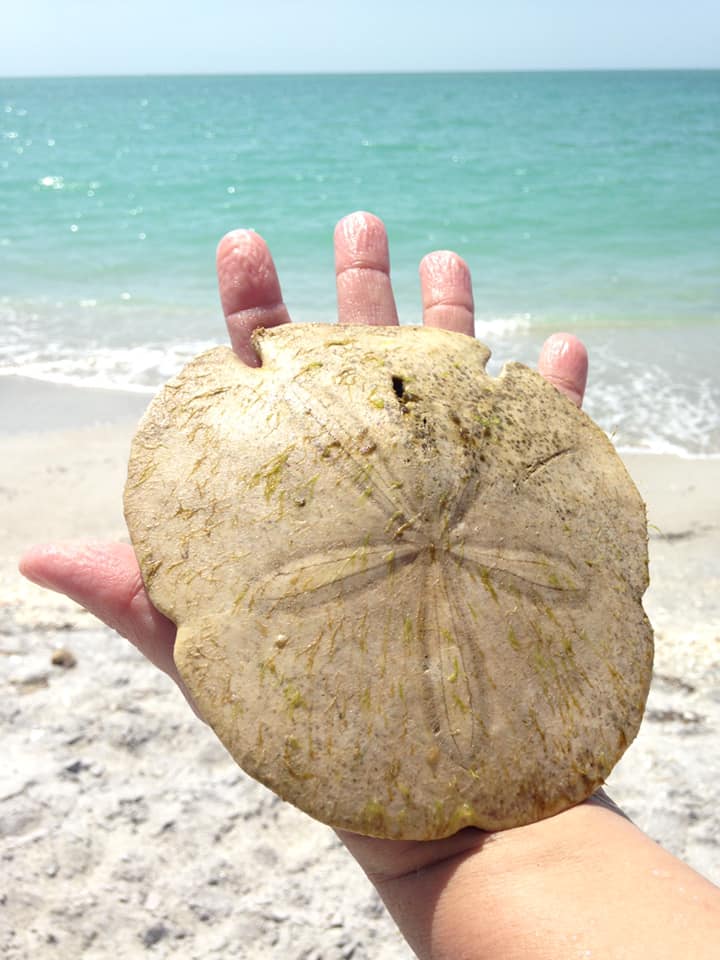
A living sand dollar is dark: brown, purple, gray or green, under dense short movable spines that move if you watch them. The white disc is the bleached test of an animal that died some time ago. If what you found is still dark, set it on your palm for a minute. A live animal stains skin yellow with echinochrome, a harmless pigment, and that is the fastest field test there is. Our echinochrome stain page covers what it does and does not tell you.
One complication: not every dark test is a live animal. Black or gray staining is usually iron sulfide from burial in oxygen-poor sediment, and it happens to recently dead material as readily as to old, so black does not mean fossil either. Our fossil sand dollars page takes that apart.
The rule on our boat is empty shells only, and that is our own house rule rather than a statute. It happens to line up with the law on City of Marco Island beaches, where city code section 54-36(o) prohibits live shelling. Florida statute 379.101(34) is why live and empty are different questions: it counts living echinoderms as saltwater fish and expressly excludes nonliving shells. Read FWC's sea shell collecting page rather than anyone's summary, ours included.
How to Record One Honestly
There is an established convention for a find you cannot take to species, it is used in real collections, and it costs you nothing.
- Encope sp. means genus Encope, species undetermined. A complete and respectable identification.
- Encope cf. michelini means this compares with Encope michelini. The "cf." is the Latin confer, compare: it records which way you leaned without claiming you settled it.
- Encope michelini, written bare, is a determination. Write it only if you made one.
Around the name, record observations rather than conclusions. The date. The beach, and the most specific position you can give. Whether the animal was alive or already a bare test. Whether each opening broke the outline or sat enclosed inside it, and whether its edge looked finished or fractured. Whether the test was whole.
Photograph both faces before it breaks, because eventually it will. The underside is the face people skip, and it carries the mouth, the food grooves and the anal opening near the margin. iNaturalist is a good place for a second opinion, where genus-level identifications are normal. What you must not do is quietly upgrade a guess: once "probably michelini" is copied onto a card as "michelini", the record is false.
Keep it away from acidic vapor, which some woods and cardboards give off and which causes Byne's disease; our shell collecting page has the rest. To check a name, use the World Register of Marine Species and not MolluscaBase: a sand dollar is not a mollusk, so an empty search there means the wrong register, not a bad name.
If you would rather ask a person than a database, that is what the ride back is for. We run three trips a day out of San Marco Marina in Goodland, and you can reserve a seat here.
Questions people actually ask
What is a notched sand dollar?
It is a sand dollar in the genus Encope, built with indentations cut in from the rim rather than the clean enclosed slots that pierce a Mellita. The test is also heavier and thicker. On Florida coasts the species to know is Encope michelini, whose US Fish and Wildlife Service common name is the Notched Sand Dollar. It occurs on both Florida coasts and Gulf-wide.
How do I tell a notch from a lunule?
Trace the outline of the disc rather than looking at the opening. If the boundary runs smoothly past it and the opening sits inside, that is a lunule. If the boundary detours inward and comes back out to the rim, that is a notch. Holding the test up to the light does not help, because both kinds of opening pass light equally well.
How many notches does an Encope have?
We are not going to give you a number, because we have not verified one against a primary source and this page is about not repeating unchecked claims. It is also the wrong question. Counting works for the enclosed-slot animals, five for Mellita and six for Leodia sexiesperforata. For Encope the check is whether the openings break the outline of the disc and how their edges are finished.
Is the "inflated sand dollar" a real name?
Not for an Encope. FWC uses "inflated" for Clypeaster rosaceus, the inflated sea biscuit, and a sea biscuit is not a sand dollar. It is thick and domed rather than flat, with no lunules, though it does sit in the same order, Clypeasteroida. If a label reads inflated sand dollar, the word has been borrowed from a different animal.
Is the arrowhead sand dollar a species?
No. Arrowhead is a vendor nickname, applied inconsistently across several Encope species, which is exactly why it identifies nothing. There is no type specimen, no register entry, no agency list and no published description behind it. Use it in conversation if you like, but never write it on a label where a determination belongs.
Are Encope and Mellita the same animal?
No. They are separate genera in the same order, Clypeasteroida. A Mellita is thin, roughly a millimeter of fused plate, with enclosed lunules inside an unbroken outline. An Encope is heavier and thicker, with notches that break the outline at the rim. A worn specimen can blur the two, which is why the edge finish matters more than the silhouette.
Is Encope aberrans a valid species?
That is genuinely unsettled and we do not take a side. The World Register of Marine Species currently lists Encope aberrans as a junior synonym of Encope michelini. Coppard and Lessios, writing in Scientific Reports in 2017, used molecular phylogenetics, found the two to be monophyletic sympatric species that diverged around six million years ago, and rejected the synonymy. Our Encope problem page explains how a question like that gets settled.
Where this comes from
Every factual claim on this page traces to a published source. Where the science or the law is genuinely unsettled, we say so on the page rather than pick the tidier answer.
Come find them with us
Three trips a day out of Goodland, into water the road does not reach. Captain-led, family-friendly, and timed to the tide.