
Is This Sand Dollar Alive? The Field Test
Check it in this order: color first, then the spines, then how it feels and what it weighs, then smell, and only then the yellow palm test. Dark and fuzzy with spines that move is a living animal, and it goes back in the water right side up now, not after a turn in the bucket. Bleached white and chalky is the skeleton of something that died long ago, and it costs nothing to take. The part nobody tells you: every signal on this list can only prove life, never death, so a dark disc you are unsure about goes back too.
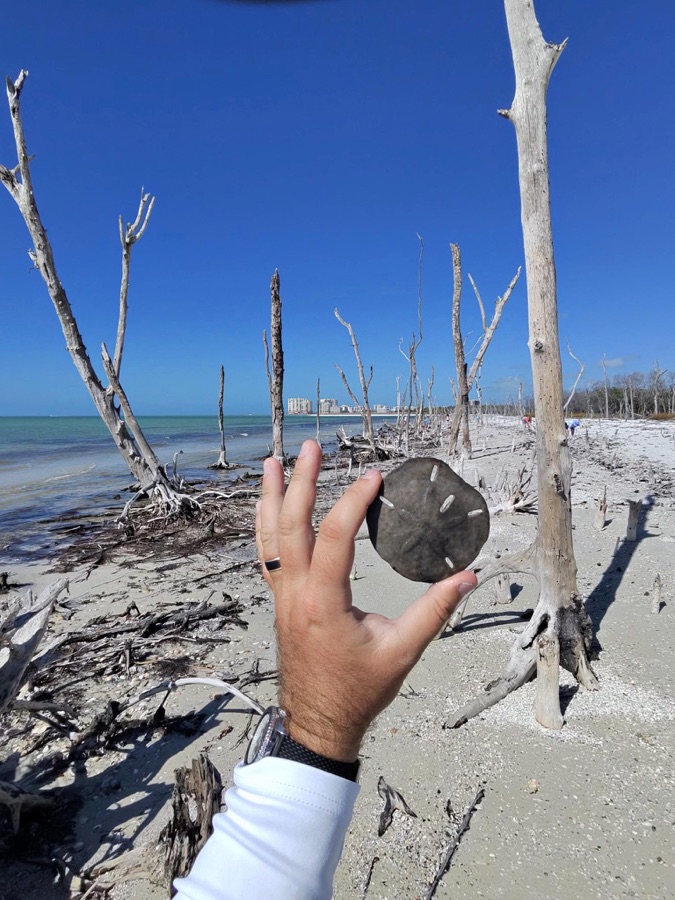
Why the question comes before the answer
Most pages answer how to tell before they answer why it is worth the ten seconds. Get that order right and the rest is easy to remember.
A white disc in dry sand is the bleached skeleton of an animal that died a long time ago. Picking it up costs nothing. A dark disc at the waterline is a different object entirely. It may be an animal that is alive right now, worked into the top layer of sand, doing what it has done for years.
Put that animal in a bucket and you have not postponed the question, you have answered it. Bucket water on a hot deck heats fast, the oxygen goes, and there is no soft bottom to burrow into. We will not hand you a survival time in hours, because we have not seen one published for our Gulf animals and neither has anybody else. What we will tell you plainly is that "I will check it later, back at the room" is the plan that kills them. The check happens where you are standing or it does not happen.
The short version
- A living sand dollar is brown, purple, gray or green and covered top and bottom in a dense mat of short movable spines. The familiar white disc is the bleached test of an animal that died a long time ago.
- Spine movement is the clearest single signal. Rest the disc flat on an open palm, brace your arm, watch the margin in silhouette, and give it ten seconds.
- Every check here runs one way. Moving spines prove life. A dark, quiet, unstained disc proves nothing, because an animal that died recently can still look dark and still hold most of its spines.
- Weight is a supporting signal only: a long dead test that filled with wet sand weighs plenty. Nothing living rattles.
- Florida statute 379.101(34) counts a living echinoderm as saltwater fish and expressly excludes nonliving shells and echinoderms. A live one needs a Florida recreational saltwater fishing license. An empty test needs nothing.
- When you cannot tell, put it back. Our rule aboard is empty shells only, whatever the field test said.
Your captain reads the tide, picks the day's beach and helps identify what turns up.
Find these on a tourThe order to run it in
Five signals, and the order is not arbitrary. Each is cheaper than the one after it, and most discs are settled by the first two.
- Color. From arm's length, before you pick it up.
- Spines. Are they there, and are they moving.
- Feel and weight. What the surface does against your skin, and what it weighs for its size.
- Smell. Useful in one direction only, but free.
- The yellow stain. The confirming test, and only if you still need one.
Underneath all five sits a sixth thing that is not a test at all: where the disc was lying when you found it. That one does more work than people realize, and it gets its own section below.
Color, from arm's length
Color goes first because it is free, it works at a distance, and it settles most cases outright.
Bleached white, or near it. Long dead. Tissue, spines and pigment are all gone and sun and surf finished the job. Nothing you do next changes that answer.
Dark: brown, purple, gray, green, or a dull mix. Alive, or dead recently enough that the color has not gone yet. Read that carefully, because it is the sentence people skip. Dark does not mean alive. It means the question is still open and you keep going down the list.
One lookalike is worth knowing. Black or gray staining on an otherwise bare test is usually iron sulfide from burial in oxygen poor mud, and it can happen to something that died fairly recently. A hard, hollow, spineless disc with dark staining is not a living animal's color, and the next check separates the two in seconds.
The spines, and whether they are moving
If you take one thing from this page, take this. Spine movement is the clearest single signal there is, it costs ten seconds, and unlike color it is not ambiguous.
A living sand dollar is covered, top and bottom, in a dense mat of short movable spines. Nothing like the long spines of a rock urchin: fine, close and velvety, so the whole surface looks faintly fuzzy in a way a bare test never does. How a sand dollar moves covers what they are doing down there.
Seeing them move is a matter of technique, and it is one almost nobody uses on the first try.
- Hold still. Rest the disc flat on an open palm and brace your forearm against your knee. The commonest reason a person reports no movement is that their own hand was moving more than the spines were.
- Watch the edge, not the face. Look at the margin in silhouette against the sky or against wet sand. Spines break the outline, and an outline that shifts is unmistakable, where the same motion across the flat face is nearly invisible.
- Get the glare off it. Turn so the sun is behind your shoulder. Light bouncing off a wet surface hides exactly what you are looking for.
- Give it ten seconds. The movement is slow and collective, more like grass in wind than a twitch.
Turn it over for a second version of the same signal: fine pale tube feet extending and retracting around the central mouth and along the food grooves. Slower to spot, and conclusive when you do.
One caution, and it is the reason the rest of this page exists. An animal that died recently can still be wearing most of its spines, and they will sit there and do nothing. Presence of spines is weak evidence. Movement is the evidence.
Feel, weight and smell
These three will not settle a hard case alone. They confirm a call you have already made, and catch you when you made it too fast.
Feel. A living one is damp all the way through and faintly grippy. The spines catch slightly on the ridges of your fingers, and set on an open palm it holds rather than sliding off. A long dead test feels like chalk: smooth, finely pitted, oddly dry even when wet, and it slides. Carry a known white test in the other hand and compare. Two seconds of comparison teaches more than a paragraph.
Weight. A living one is heavy for its size, because the space inside is full of tissue and water instead of air. Useful, never decisive: a bare test that filled with wet sand through the slots and the mouth weighs plenty too.
Rattle. Tip it gently near your ear. A dry rattle is sand, or the loose jaw pyramids of Aristotle's lantern knocking around inside an empty test. Nothing living rattles. Tip it, do not shake it: the test is roughly a millimeter thick.
Smell. A living one smells like the water, which is to say like almost nothing. A sour, rotten smell means an animal died and has begun to break down. Notice which way that points: smell can tell you something is dead, and it can never tell you something is alive.
The yellow stain, last, and only if you still need it
If the disc is still dark and the first four checks have left you genuinely unsure, there is one more test and it is the fastest confirming one there is.
Dry your hand on your shirt. Rest the disc flat on the dry palm and wait about a minute. If yellow spreads onto your skin, the animal is alive. The pigment is echinochrome, it is harmless to handle, and the answer is final in the one direction it works: yellow means alive, and no yellow means nothing at all.
That is as far as this page takes it, deliberately. The echinochrome stain test covers the pigment, why it transfers onto skin, and every way the test misfires.
Where it was lying is evidence too
Nobody teaches this one, and it does more work than any signal on the disc itself. Before you pick anything up, notice where it is.
- Up in dry sand above the wrack line, warm to the touch. Long dead, near enough without exception. Anything that spent the morning up there is not a living animal.
- Half worked into wet sand on a flat at low water. This is where a living one lives. Sand dollars burrow into the top layer, so what you see is a disc shaped bulge or a shallow oval outline rather than an object sitting on top. If you had to scuff it loose, assume alive until the spines say otherwise.
- Rolling loose in the swash. Genuinely ambiguous. It could be a living animal washed out an hour ago, or one that died two days back. This is the case the rest of the page is for.
- In a windrow of broken shell along the tideline. Almost always long dead, and usually chipped. That damage is readable in its own right, and what eats them works through what drill holes and crushing do and do not tell you.
Position tells you one more thing. Find a living one on a flat and you should look at your feet before the next step. These animals live in dense aggregations that reach hundreds per square meter in some populations, and a bed is not something to walk across.
The ten second version, with wet hands and a child waiting
Everything above assumes time and two free hands. You will have neither. The real version happens standing in four inches of water, glare off everything, one hand soaked, somebody small pulling your wrist.
Compressed, it still works.
- White and chalky? It is yours. Done.
- Dark? Flat on an open palm, arm braced, count to ten out loud, watch the edge. Moving means alive, and it goes back now.
- Still not sure? It goes back.
Three notes that matter in real conditions. Dry one hand on your shirt first, because every signal here reads better on dry skin and the stain test requires it. Turn so the sun is behind you. And say the reason out loud while you work, because everyone near you is learning the rule from your sentence, not from your reasoning.
Yes, it is alive. Now put it back properly.
The decision is made. The next half minute matters more than the ten seconds you spent making it.
- Back in the water, not onto wet sand and not into a bucket while you keep looking.
- Right side up. Five petal figure up, mouth down against the bottom. The anatomy page shows both faces if you cannot tell them apart yet.
- Near where it came from, at about the same depth and on the same soft bottom.
- Set it down, do not throw it. The test is about a millimeter thick and fails at a point load, which is precisely what a landing is. Why they break explains the structure.
- No fresh water. No rinse under a spigot, no cooler, no drinking bottle.
- Do not pass it around first. One person, one look, back in the water. A dark disc that goes around a group of eight is out of the water eight times longer than it needed to be.
If you want a photograph, take it with the animal sitting in an inch of water at your feet rather than held up against the sky. It is a better picture anyway.
How this test fails, and it fails the same way every time
Every method has failure modes, and the honest ones get published. Here are these.
- Recently dead, still dark, still spiny. The one that matters. An animal that died a day or two ago passes the color check, the feel check and the weight check, and holds most of its spines. Nothing moves, and the palm may give you little or nothing.
- A stressed animal goes still. A live one that has been out of the water, squeezed, or sitting in the sun can stop moving its spines. Stillness is not proof.
- You did not look long enough. A glance is not the spine test. The spine test is ten held seconds.
- Sand. A disc caked in wet sand reads as a lump of sand, and the coating hides both color and movement.
- Wet hands and glare. Both cost you signals, and neither announces itself.
Look at the shape of that list. Every failure on it makes a living animal look dead. Not one makes a bleached white test look alive, and there is no mechanism by which one could: a long dead test cannot grow spines, regain color, or stain a palm.
Which brings up the point sitting under the whole page. The absence of a signal proves nothing. Every check here is a one way door. Moving spines prove life. Yellow proves life. A rotten smell proves something died. Nothing on the list can prove that a dark, quiet, unstained disc is dead, and no field test can. What you get is a good read, plus a rule for the times the read comes up short.
When you genuinely cannot tell
Put it back.
That is not a hedge. It is arithmetic, and the two mistakes are nowhere near the same size.
Put back a dark disc that turns out to have been empty, and you lost a keepsake you could have replaced with any of the white ones lying up the beach. That is the whole cost.
Take home a dark disc that turns out to have been alive, and you killed an animal, you are carrying a decomposing echinoderm in a bag in a warm car, and you took a living echinoderm rather than an empty test, which Florida law treats as two different acts. The legal page works through that line properly.
Say "I do not know" out loud when you do not know. It is a correct answer, it has an action attached, and the action is the water.
Teaching a child to run the same test
Children are better at this than adults, for one reason: asked to hold still and stare at something for ten seconds, they will actually do it.
- Give them the job of checker, not collector. It is a promotion, and it flips the incentive. A collector wants the answer to be dead. A checker only wants to be right.
- Put a white one in their other hand. Comparison teaches in seconds what description does not teach at all. Chalky and light in one hand, fuzzy and heavy in the other, and the lesson is over.
- Give them the sentence. "Dark and fuzzy goes back. White and chalky is mine." Rhythm is what survives the ride home.
- Two flat palms, never pinched fingers. Pinching squeezes a living animal and snaps a dry test, and small hands pinch by default.
- Make them count to ten out loud. This is the trick. A counting child holds still. An adult checking a phone does not.
- Let them do the release. Walking it back and setting it down petals up is the part they will describe to somebody later.
- Never make "I do not know" a wrong answer. Praise it, then put it back together. A child who learns that uncertainty gets them corrected will start guessing, and a guess always guesses dead.
One more thing, and it does more work than any rule on that list. Tell them what they are holding. It is an animal, closer kin to a sea urchin than to a sea star, with its mouth on the bottom and its skeleton on the inside. The sand dollar codex has the rest. Children who understand it is an animal put it back without being asked.
What alive settles legally, and what it does not
Live or empty is the cleanest line in Florida shelling law, and it is worth knowing exactly where it sits.
Florida statute 379.101(34) defines "saltwater fish" to include living mollusks and echinoderms, and expressly excludes nonliving shells and echinoderms. So taking a live sand dollar requires a Florida recreational saltwater fishing license, while an empty test is a piece of calcium carbonate and requires nothing. One word, alive, moves the object from one category into the other.
What the field test does not settle is where you are standing, and the ground can be stricter than the animal's status. Florida State Parks prohibit removing shells, sand, rocks or marine animals from any park area, empty ones included. Collecting is prohibited outright in Everglades National Park and in Ten Thousand Islands National Wildlife Refuge. The City of Marco Island bans live shelling under city code section 54-36(o) and bans removing sand from the beach under 54-36(k). Lee County prohibits taking live shellfish. Collier County has no county wide shell ordinance.
We publish no figure for how many empty tests a person may carry off a beach, because we could not verify one. Two independent reviews of FWC's rules reached different conclusions on that exact question. We have put it to the Florida Fish and Wildlife Conservation Commission in writing and will publish their answer with the date it arrives. Until then, read FWC's own sea shell page and take conservatively. Our legal page lays out both readings.
Why we run empty shells only either way
Our rule aboard is short and it is ours: empty shells only. It holds whatever the field test said, and it covers sand dollars, whelks, conchs, urchins and anything else that might still have an animal inside it.
The reason is everything above. The test is good. It is not perfect, it fails in one direction only, and a boat deck full of people with a tide running is the worst possible place to adjudicate a close call. One rule everybody remembers at the rail beats a decision tree nobody runs correctly under pressure.
There is a second reason, less obvious and probably more important. If keeping the dark one stays on the table whenever it turns out to be dead, then some part of you wants it to be dead, and that part is at your shoulder while you decide whether the spines moved. Take the reward off the table and the checking gets honest.
Some of the water we run sits inside protected areas whose rules appear stricter than empty shells only, and we are confirming that in writing rather than guessing, so we do not tell anybody where they may fill a bag. What we teach on every landing is the sentence at the top of this page. Dark and fuzzy: leave it. White and chalky: it is yours. Not sure: the water. If you would rather learn it with one in your hand, trips run three times a day out of San Marco Marina in Goodland and you can reserve a seat.
Questions people actually ask
How can you tell if a sand dollar is alive or dead?
Check color first. A living sand dollar is brown, purple, gray or green and a long dead one is bleached white. If it is dark, rest it flat on an open palm, brace your arm and watch the margin for ten seconds. Dense short spines that move mean the animal is alive. Feel, weight and smell back the call up, and the yellow palm stain confirms it.
Are white sand dollars dead?
Yes. A bleached white disc is the test, an internal skeleton of fused plates, left after the tissue, the spines and the pigment are gone and sun and surf have finished bleaching what remained. There is no such thing as a living white sand dollar on a beach. That is also why the white ones are the ones worth picking up: nothing had to die for them.
Can a sand dollar look dark and still be dead?
Yes, and this is the failure that matters most. An animal that died a day or two ago can keep its dark color, keep most of its spines, feel damp and weigh heavy, and give you nothing on the palm test. Every one of these checks can prove life. None of them can prove death. So a dark disc that gives you no clear yes still goes back in the water.
What should I do if I pick up a live sand dollar?
Put it straight back in the water, not on wet sand and not in a bucket. Set it down right side up, five petal figure up and the mouth against the bottom, near where you found it, at about the same depth and on the same soft bottom. Set it, do not throw it: the test is roughly a millimeter thick. Then stop handling it and give the spot some room.
How do I teach my kids to check a sand dollar?
Make them the checker rather than the collector, which flips the incentive. Put a known white test in their other hand so they can compare. Give them the sentence: dark and fuzzy goes back, white and chalky is mine. Two flat palms, never pinched fingers. Have them count to ten out loud while watching the edge, because a counting child actually holds still. And let them do the release.
Does a live sand dollar move in your hand?
The spines do, and the tube feet on the underside do, but the animal itself does not squirm or struggle the way people expect. The movement is slow and collective, more like grass in wind than a twitch, which is why a two second glance misses it. Hold the disc still, look at the margin in silhouette with the sun behind you, and give it ten seconds.
Is it illegal to take a live sand dollar in Florida?
Florida statute 379.101(34) counts living echinoderms as saltwater fish and expressly excludes nonliving shells, so taking a live one requires a Florida recreational saltwater fishing license while an empty test requires nothing. Where you stand can be stricter still: state parks, Everglades National Park, Ten Thousand Islands National Wildlife Refuge and the City of Marco Island all have their own rules. Our rule aboard is empty shells only.
Where this comes from
Every factual claim on this page traces to a published source. Where the science or the law is genuinely unsettled, we say so on the page rather than pick the tidier answer.
Come find them with us
Three trips a day out of Goodland, into water the road does not reach. Captain-led, family-friendly, and timed to the tide.