Sand Dollars and the Law: What Is Settled, and What Is Not
Florida statute 379.101(34) draws the cleanest line in this whole subject: a living sand dollar counts as saltwater fish, so taking one is fishing and requires a Florida recreational saltwater fishing license, while an empty test is expressly not saltwater fish and needs no license at all. Whether any numeric collecting limit applies to sand dollars is a separate question, and it is genuinely unsettled, because two independent reviews of the same rules came back disagreeing, so we publish no number in either direction. Florida State Parks, Everglades National Park and Ten Thousand Islands National Wildlife Refuge prohibit collecting outright, empty tests included, and aboard our boat the rule is empty shells only.
The One Line in Florida Law That Is Not in Doubt
Start where the ground is solid. Section 379.101(34) of the Florida Statutes defines what "saltwater fish" means for the state's saltwater fishing rules, and the definition is broader than the word sounds. It takes in living mollusks and living echinoderms. It expressly excludes nonliving ones.
A sand dollar is an echinoderm, and more precisely an echinoid: a sea urchin, one of the flattened irregular ones, which is the correction our page on sand dollars versus sea urchins is built around. So that one definition sorts every sand dollar on this coast into two piles, using a single test, alive or not.
- A living sand dollar is saltwater fish. Taking one is fishing, and recreational saltwater fishing in Florida requires a Florida recreational saltwater fishing license.
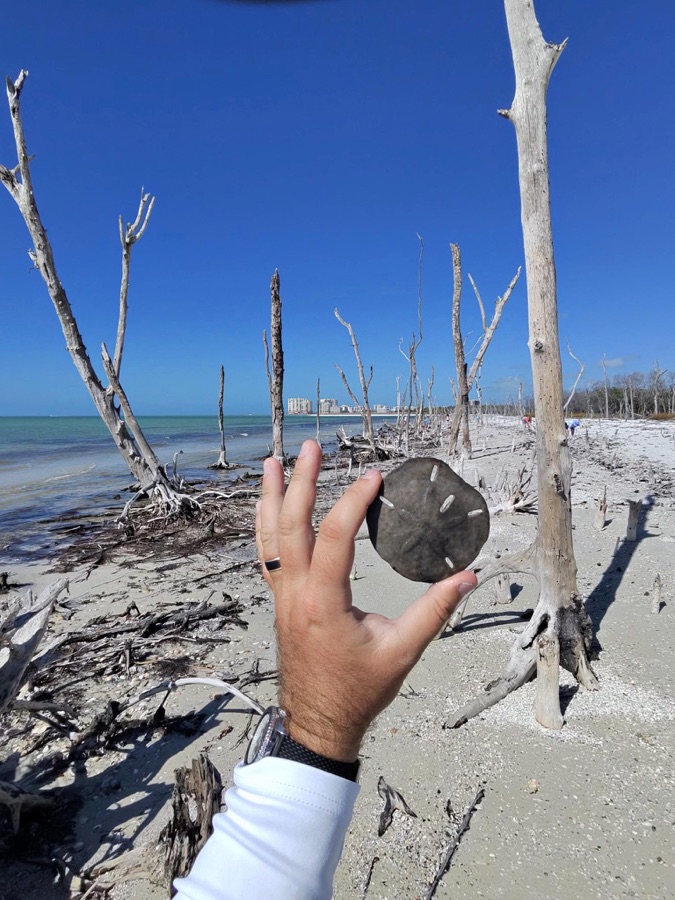
- An empty test is not saltwater fish. The bleached disc most people mean by "sand dollar" is the animal's internal skeleton, covered on our anatomy page. Under this statute it is an object, and picking one up needs no license.
That is the cleanest line in Florida shelling law, and most of this page hangs off it. It also means "is this thing alive?" is not only a biological question. On a Florida beach it decides which rules you are standing in.
The short version
- Section 379.101(34) of the Florida Statutes defines saltwater fish to include living mollusks and echinoderms and expressly excludes nonliving ones. A sand dollar is an echinoderm, so live and empty fall on opposite sides of that sentence.
- Whether a numeric collecting limit applies to sand dollars in Florida is unsettled. Two independent reviews of FWC's rules reached different conclusions, so we publish no number, in either direction.
- Rule 68B-42.001(3)(o) of the Florida Administrative Code defines restricted sea urchins as any species of the Class Echinoidea, except longspine urchin, Diadema antillarum, and sand dollars and sea biscuits, Order Clypeasteroida. That carve-out is the crux of the disagreement.
- We have asked FWC in writing. When the agency answers we will publish the answer on this page with the date we received it.
- Florida State Parks, Everglades National Park (36 CFR 2.1) and Ten Thousand Islands National Wildlife Refuge (50 CFR 27.51 and 27.61) all prohibit collecting, empty tests included.
- Collier County has no county-wide shell ordinance, but the City of Marco Island has its own code: 54-36(o), "No live shelling", with 54-36(k) on removing sand and 54-36(p) on collecting crustaceans.
Your captain reads the tide, picks the day's beach and helps identify what turns up.
Find these on a tourLive or Empty, Decided in Your Hand
A line that clean still has to be applied by a person crouched on wet sand with a child waiting.
A living sand dollar is dark: brown, purple, gray or green, and covered in dense short spines that move. The bright white disc is a bleached test, and the animal that built it died long ago. If something dark leaves a yellow mark on your palm within about a minute, it is alive. The pigment is echinochrome, it is harmless, and it is the fastest field test there is.
Both get proper treatment elsewhere. The full sequence, including the failure modes, is on how to tell if a sand dollar is alive, and the pigment is on the echinochrome stain page.
The part worth carrying into a legal page is the honest limit. A recently dead animal can still look dark, and an absence of stain proves less than people assume. If you cannot establish that a thing is empty, you have not established the easy case.
Three Places Where There Is No Argument At All
On some ground the live-versus-empty distinction never comes up, because the answer is the same either way.
- Florida State Parks. Removing shells, sand, rocks or marine animals from any park area is prohibited. Empty shells included. A park rule is about taking things out of the park, so what the statute says about nonliving echinoderms does not help you there.
- Everglades National Park. Collecting is prohibited outright. The general federal rule is 36 CFR 2.1, which lets a park superintendent designate certain items as collectible; the Everglades compendium designates only dead wood. Seashells have never been on that list.
- Ten Thousand Islands National Wildlife Refuge. Prohibited under 50 CFR 27.51 and 27.61.
The last two sit directly against the water we run out of Goodland, and a boundary in the Ten Thousand Islands is not something you can see from a boat. Mangrove looks like mangrove. Nothing out there is signposted the way a park gate is.
So the first question is never "what does the rule say". It is "whose ground am I standing on", and that is the step almost everyone skips.
The County Line and the City Line
Florida's shell rules are not uniform across the state, and the local layer is where confident internet answers go wrong most often.
Only two counties are named in the state's Southwest Florida Shells rule chapter: Lee and Manatee. Lee County, which covers Sanibel, Captiva and Fort Myers Beach, prohibits taking live shellfish with narrow exceptions. That is where the region's reputation for strictness comes from, and it is real.
Collier County, where we run, has no county-wide shell ordinance. That is a fact, and it is also the most misread fact on this page. No county ordinance does not mean no rules. It means the rules that apply come from somewhere else: the state, a park, a refuge, or a city.
The City of Marco Island is exactly that somewhere else. Three provisions of its code are worth knowing:
- 54-36(o): "No live shelling."
- 54-36(k): removing sand from the beach is prohibited.
- 54-36(p): collecting crustaceans is prohibited.
A city ordinance applies inside that city, and a county with no ordinance does not cancel one. Same lesson as the section above, in a different costume.
Two Per Species, Four Per Vessel
Before the unsettled part, the settled myth, because it is the best possible warm-up for it.
"Two live shells per species per person, four per vessel" is not Florida law. It traces to a Lee County ordinance repealed in 2002. It is probably the most copied wrong fact in shelling content, and you will still find it in rental-office brochures, in articles published this year, and on pages that look far more official than this one.
What is worth studying is not that it is wrong but how it got everywhere. One plausible number, in print, from a source that once had a reason to say it. Somebody repeated it without checking. Somebody repeated the repetition. Twenty years later it is quoted as current statewide law by people who fully intend to be helpful. Nobody in that chain lied. Nobody opened the ordinance either. Hold that pattern for the next few sections, because it is the pattern we have decided not to add to.
Now the Part Nobody Else Will Tell You
Here is the question we cannot answer, and the reason this page exists at all.
Whether Florida imposes a numeric collecting limit on sand dollars has been reviewed twice, independently, against the same body of rules. The two reviews came back disagreeing with each other.
- One reading started from FWC's public recreational sea shell collecting page and read it as covering sand dollars, which would bring them under what that page describes.
- The other reading went to the rule text itself, at 68B-42.001(3)(o) of the Florida Administrative Code, and found sand dollars written out of the definition by name.
We are not publishing a number. Not the one the first reading would produce, and not "there is no restriction" either, because that is equally a claim and we cannot stand behind it. A page that prints a number it cannot source is not being helpful. It is manufacturing the next twenty years of the myth in the section above.
An open question, published as open, with both readings shown and the citation you need to check them, is worth more than a confident sentence that turns out to be wrong on somebody else's beach.
The Sentence the Whole Question Turns On
Rule 68B-42.001(3)(o) defines what the state means by restricted sea urchins. This is the definition, with the emphasis added by us:
Any species of the Class Echinoidea, except longspine urchin, Diadema antillarum, and sand dollars and sea biscuits, Order Clypeasteroida.
Read it twice, because it does two opposite things inside one sentence.
First it casts as wide as it possibly could: any species of the Class Echinoidea. Sand dollars are in the Class Echinoidea. They are not urchin relatives, they are urchins, which is the point of our urchin comparison. If the sentence ended there, sand dollars would sit plainly inside it and there would be nothing to discuss.
Then the word except takes them straight back out, by common name and by order: sand dollars and sea biscuits, Order Clypeasteroida. That is not vagueness or an oversight. Somebody wrote that exclusion deliberately, and named the order that holds both sand dollars and their thick domed cousins the sea biscuits.
That explicit carve-out is the crux. It is why a careful person reading the rule text lands somewhere different from a careful person reading a summary of it.
Why Both Readings Are Defensible
Neither review was careless. They were reading different documents, and both documents are real.
An agency's public-facing page is a plain-language summary, written so a member of the public can act on it without a rule chapter open. That is a legitimate thing to publish, and it is how nearly everybody actually meets a regulation. A chapter of the Florida Administrative Code is the operative text: longer, colder, full of definitions that only make sense against each other.
There is a second reason two readings can diverge, and it is the more interesting one. The restricted-species framework is one part of a very large body of rules. A species sitting outside one definition tells you about that definition. It does not tell you what every other rule does. Sorting out which rule reaches a given animal is the work an agency does, and the work a boat crew should not be doing on a web page.
So we will not tell you one reading beat the other. We can tell you where each came from, so you can look at both.
Out of One List Is Not Out of Every Rule
The most dangerous way to read that carve-out is as permission. The sentence itself carries the argument against that, sitting right there in the same line.
Look at who else is named in the exclusion: the longspine urchin, Diadema antillarum. That animal is written out of the definition of restricted sea urchins in the same breath as sand dollars. It is also, separately, prohibited from harvest entirely in Florida. So is the Bahama starfish: totally harvest-prohibited statewide.
Whatever that exclusion does, then, it cannot mean "unregulated", because at least one species named in it cannot be taken at all. Being outside one definition means the answer lives somewhere else in the rules. It does not mean there is no answer.
So the honest conclusion is narrower than either camp would like. The carve-out is real and explicit, and it is a genuine reason to doubt a confident number. It is not, on its own, a green light.
What We Have Done About It
We asked. We have put the question to FWC in writing, and when the agency answers, that answer goes on this page with the date we received it.
If it produces a number, we will publish the number and say exactly where it came from. If the answer is that nothing numeric applies, we will publish that. Either way it will be attributed and dated, so a reader in three years can see how old it is and decide whether to re-check. Undated regulatory claims are how the two-per-species myth survived twenty years past its repeal.
Until then, read the agency rather than us: FWC's recreational sea shell collecting page. Any page written on a fixed date is only as current as its last revision, this one included.
And if you hold something that settles it, a rule citation we have missed, a written response, a formal opinion, send it to us. We would rather be corrected in public than be one more site repeating a guess with confidence.
The Ground We Are Still Checking
There is a second open question on this coast, and it is about place rather than number.
Rookery Bay National Estuarine Research Reserve is managed under Florida Administrative Code 18-23.007, and that rule prohibits removal of any plant or animal, living or dead. Those last two words are the ones that matter. They are stricter than the line the statute draws, because the statute's carve-out for nonliving echinoderms is exactly what a phrase like "living or dead" is written to close.
Whether that rule reaches the specific islands our trips visit is not something we have confirmed, and we are working on it with the Reserve. Until it comes back, we do not publish permission to collect at any named island, here or anywhere else on this site.
When we have a clear answer for the water we run, it will go here in the same form as the FWC answer: plainly, attributed, and dated.
Getting One Home
Two travel questions come up constantly, and both have clear answers.
Flying with one. TSA allows clean, dry shells in carry-on and in checked bags, and its own guidance is published here. Clean and dry are doing real work in that sentence, and not only for the screening line: a damp test in a closed bag becomes a smell problem, and a loose one becomes fragments, for the structural reasons set out on why sand dollars break.
Bringing one into the country. Every seashell entering the United States from abroad must be declared to the US Fish and Wildlife Service, protected or not, personal or commercial. A disc from a Caribbean beach is covered. A disc from a Florida beach flying home to Ohio is not an import and that rule does not touch it.
One thing a suitcase never does is change where the object came from. If a test was picked up on ground where collecting is prohibited, the prohibition applied at the moment it left the sand.
Our Own Rule, Which Is Not the Law
Aboard our boat the rule is empty shells only. That is our rule, not the state's, and we want the difference stated plainly, because this whole page has been about not confusing the two.
On City of Marco Island beaches the same rule happens to also be law, under 54-36(o). That is an alignment, not the reason. We would run the boat this way if no ordinance existed anywhere.
The reason is simpler than a rule. A living sand dollar is in the middle of doing something: feeding along its underside, holding position in a bed with hundreds of others, work covered on how they eat and sand dollar beds. A dead one has finished. Keeping the empty one costs a guest nothing and leaves the flat intact for the trip after ours. It also means our crew never has to settle an unresolved regulatory question in shin-deep water with a family waiting.
One footnote for when you see them by the bagful in a craft store. Sand dollars sold in bulk were alive when they were taken, and taken at scale. We cover that on sand dollars in craft and art. Nobody needs a lecture about a wreath. You are simply entitled to know what you are looking at.
How to Check Any Beach Before You Go
We are a boat crew, not lawyers, and none of this is legal advice. It is a description of what the rules say and where they live, so that you can read them rather than trust us. The order matters more than the effort.
- Work out who owns the ground. State park, national park, national wildlife refuge, research reserve, city beach, county beach, or private property. This one answer changes everything below it, and it is the step people skip.
- If it is a park or a refuge, stop there. Those prohibitions are the strictest, they cover empty shells, and live versus empty does not rescue you.
- Check the city, then the county. Marco Island has its own code, and a county with no ordinance tells you nothing about the cities inside it.
- Check FWC for the state layer, at the agency's own page, close to your trip rather than from something you read last year.
- Ask when you cannot tell. Park staff, city offices and the agency itself all answer questions, and an answer in writing is worth more than any page on the internet, ours included.
When a page hands you a confident number with no citation, ask where it came from before you carry it onto a beach. That question, asked twice, is the whole reason this page reads the way it does.
Questions people actually ask
Do I need a fishing license to pick up a sand dollar in Florida?
For an empty test, no. Section 379.101(34) of the Florida Statutes defines saltwater fish to include living echinoderms and expressly excludes nonliving ones, so a bleached disc is not saltwater fish and no license attaches to it. A living sand dollar is saltwater fish, so taking one is fishing and requires a Florida recreational saltwater fishing license. That live-versus-empty line is the clearest thing in this whole subject.
Is there a bag limit on sand dollars in Florida?
We will not publish a number, because the question is genuinely unsettled. Two independent reviews of FWC's rules reached different conclusions: one read the agency's public sea shell collecting page as covering sand dollars, and the other read the rule text at 68B-42.001(3)(o), which defines restricted sea urchins as any species of the Class Echinoidea except longspine urchin, Diadema antillarum, and sand dollars and sea biscuits, Order Clypeasteroida. We have asked FWC in writing and will publish the answer with the date we get it.
Is the two per species, four per vessel rule real?
No. "Two live shells per species per person, four per vessel" is not Florida law. It traces to a Lee County ordinance repealed in 2002, and it has been copied ever since into brochures, rental-office handouts and articles published this year. If a page states it as current statewide law, that page did not check its source, which is a useful thing to know about the rest of that page too.
Can I collect sand dollars in a state park or a national park?
No. Florida State Parks prohibit removing shells, sand, rocks or marine animals from any park area, empty shells included. Collecting is prohibited outright in Everglades National Park, where 36 CFR 2.1 governs and the park compendium designates only dead wood, never seashells, and in Ten Thousand Islands National Wildlife Refuge under 50 CFR 27.51 and 27.61. On that ground the live-or-empty distinction does not help, because the answer is the same either way.
Is live shelling allowed on Marco Island?
The City of Marco Island's code says no: section 54-36(o) is titled "No live shelling." Two neighboring provisions matter as well, 54-36(k) prohibiting removal of sand from the beach and 54-36(p) prohibiting collection of crustaceans. Collier County has no county-wide shell ordinance, which surprises people, but a county having no ordinance says nothing about the city inside it. On city beaches the city code is what binds.
Can I keep a sand dollar I find on one of your trips?
The house rule aboard our boat is empty shells only, and that is our own rule rather than a statute. Beyond that, what applies depends on the ground you are standing on, and some islands in this area sit inside Rookery Bay National Estuarine Research Reserve, whose rule at F.A.C. 18-23.007 prohibits removal of any plant or animal living or dead. We are confirming that with the Reserve, so we do not publish permission for any named place. Ask the captain on the day.
Can I fly home with a sand dollar?
TSA allows clean, dry shells in both carry-on and checked bags. The real risk is breakage rather than screening, since a millimeter-thick test survives a suitcase badly. If you are bringing shells into the United States from another country, every one of them must be declared to the US Fish and Wildlife Service, protected or not, personal or commercial. A Florida shell flying to another state is not an import and that rule does not apply.
Where this comes from
Every factual claim on this page traces to a published source. Where the science or the law is genuinely unsettled, we say so on the page rather than pick the tidier answer.
Come find them with us
Three trips a day out of Goodland, into water the road does not reach. Captain-led, family-friendly, and timed to the tide.