
Why Are Sand Dollars White?
They are not. A living sand dollar is dark, brown, purple, gray or green, under a dense coat of short spines that move. The white disc you pick up is its internal skeleton, called a test, left after the animal decayed away and sun and surf took the last of the color out of what remained, which is why the whitest disc on a beach is the one that has been dead the longest.
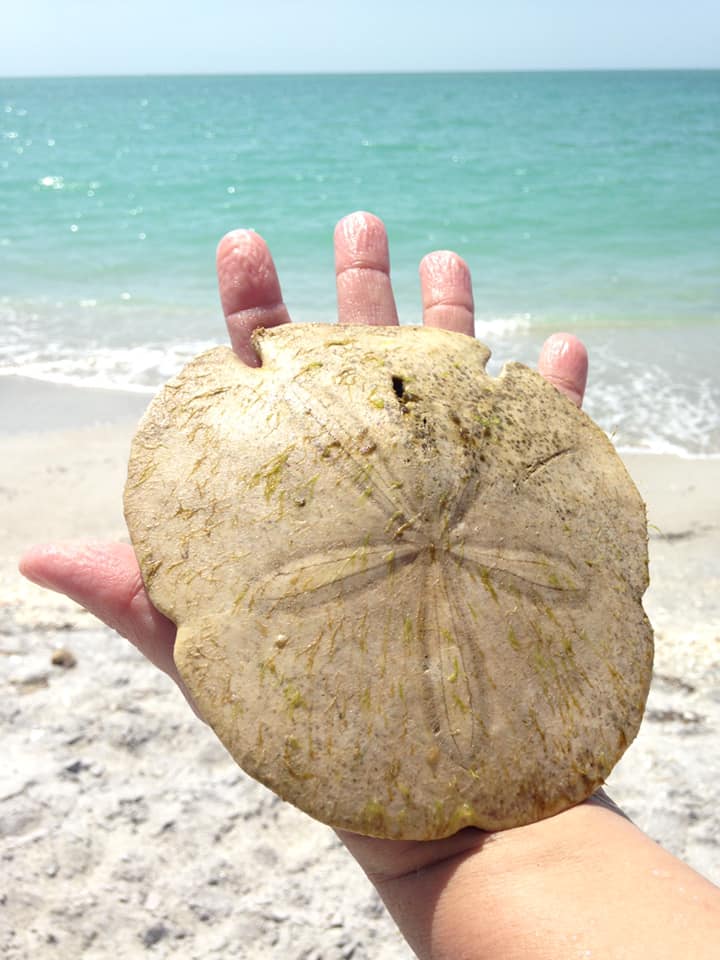
They are not white
The honest answer to this question is that they are not, and everything useful about the subject follows from saying so first.
A sand dollar, while it is alive and doing the work of being an animal, is dark. Brown, purple, gray or green, and covered all over in a dense pile of short spines that move. Nothing about it reads as white. If you have only ever seen the flat chalky disc on a shelf or in a gift shop, you have not seen a sand dollar. You have seen its skeleton, emptied by decay, rinsed by the sea and bleached by the sun.
So the real question is not why sand dollars are white. It is why the dead ones go white, and what that whiteness is worth to you as information. The short version: whiteness is a record of exposure, and the whitest disc on a beach is the one that has been dead the longest.
The short version
- A living sand dollar is brown, purple, gray or green and covered in dense short movable spines. It is never white.
- The white disc is the test: a fused, plated internal skeleton of calcite, roughly a millimeter thick.
- Nothing turns a test white. The white is the mineral underneath, revealed as pigment and tissue are taken away.
- Two processes do the work. Sunlight destroys pigment where it sits, and surf-driven sand grinds the stained outer layer off.
- Photodegradation is real, which is why a sunny windowsill is the worst place in a house to keep anything whose color you want to keep.
- Nobody has published how long a Gulf test takes to bleach, and we are not going to invent a figure.
Your captain reads the tide, picks the day's beach and helps identify what turns up.
Find these on a tourWhat color a living one actually is
Lift one out of the top layer of sand and here is what you have. A disc that is brown, purple, gray or green, sometimes close to black underwater, sometimes a dull olive. The surface is not smooth. It is a dense, even pile of short spines, and if you hold it steady in good light the whole surface shifts, because every one of those spines is moving.
It feels velvety and faintly grippy, and it is damp all the way through. It is heavy for its size, because the space inside is full of tissue and water instead of air and beach sand.
Shade varies between individuals and across a bed, and we are not going to pretend there is one correct color. What does not vary is the direction. Living sand dollars sit at the dark end of the range, all of them, always. That single fact does more work on a flat at low water than everything else on this page put together, and the full live-or-dead field test is built on it.
The white disc is a skeleton, not the animal
What you take home is a test. It is an internal skeleton, grown inside the body under a layer of skin and spines, from many plates of calcite that fuse into one rigid piece. A snail builds its shell outside itself and lives inside it. A sand dollar keeps its skeleton on the inside and wears the animal on the outside.
The wall is roughly a millimeter thick, and it is not solid mineral. Echinoderm skeleton is a fine open mesh, and in a living animal that mesh has tissue running all through it. That detail matters here more than anywhere else on the site, because a mesh full of pigmented tissue is a colored object and the same mesh emptied and rinsed is not.
What the thinness means for handling, for how a test fails, and for why most of them reach a beach in pieces is a subject of its own and is covered properly on why sand dollars break so easily. This page is about the color.
Nothing turns it white
This is the part most explanations get backwards. The sun does not paint a sand dollar white. Neither does the sea. Whiteness is not added to a test. It is what is left over.
Calcite, the form of calcium carbonate echinoderms build with, is colorless to white on its own. A test is a finely divided, porous structure made of it, and structures like that scatter light in every direction instead of letting it through, which is what makes them read as bright white. It is the same reason crushed glass is white and a windowpane is not. Nothing has to happen for a test to be white. White is its condition once it is empty and clean.
All the color in a living sand dollar is organic: pigment carried in the tissue and the fluid inside the body, running through the mesh and sitting under the spines. Take the organic material away and the mineral underneath is simply uncovered. Bleaching, in this animal, is a subtraction.
What the sun does
Sunlight breaks pigment down. That is not a claim about sand dollars specifically. Photodegradation is general and well understood, which is why curtains fade on the window side, why museums keep light levels low, and why a sunny windowsill is the worst place in a house to keep anything you care about the color of.
Applied to a test lying on open sand the effect is straightforward. Whatever pigment is still bound in the outer layer of the mesh sits under full Florida sun with nothing shading it, and the molecules carrying that color are organic. Note what this step does not involve: the color is not washed off. It is destroyed where it sits.
Sun also dries a test hard, which helps whatever organic residue is left inside break down and flush out on the next tide that reaches it. And a test on a beach does not lie still. The swash turns it, so both faces take their turn facing up. Given enough tides, everything gets its exposure.
What the surf does
The sea works the other way. It does not fade a test. It takes material off it.
Wave energy in the swash zone moves sand as an abrasive slurry, and anything light and flat caught in that is being sanded from every direction at once. On a test it shows as a rim gone round, a five-petal figure faded from crisp engraving to a ghost, and lunule edges, the slots cut through the disc, softened and slightly opened.
Every one of those is material gone. And because the pigment is concentrated in and on the outer layer, grinding that layer away whitens directly. What gets uncovered is fresh, unstained mineral. That is why a well worn test is not merely paler than a recent one but a different kind of white: flatter, chalkier, more uniform, with less of the fine surface detail a recent one still carries.
Sand sorts itself hydraulically in the swash and delivers what it has finished with to the wrack line, where most people meet their first white sand dollar. By then the work is done.
Where the pigment goes
Most of the color leaves with the animal, before sun or surf get a turn at it.
The pigment of a living sand dollar is echinochrome, and it is carried in the tissue and the body fluid rather than painted on the outside, which is why a live one rested on a dry palm stains the skin yellow within about a minute. The stain page covers the pigment and that field test in full and we are not going to repeat it here.
What matters here is the plumbing. When the animal dies the soft tissue decays and the spines drop away, and the great majority of the pigment goes with them, carried off in the water. What stays behind is whatever was bound into the outer layer of the skeleton. That residue is what sun and surf then work on, and it is the reason a freshly emptied test is usually not white yet. It is tan, or dull green, or a washed out version of the color the animal was.
What a partly colored test is telling you
A test with color still in it is fresher. Not fresh, and not alive, but nearer in time to the animal than the chalky ones lying around it.
You can see the whole gradient on one beach. Discs the color of wet cardboard. Discs white on one face and tan on the other, which usually means one side spent more of its time buried than exposed. And discs that are flatly, uniformly white, which have been out of the animal longest and getting worked on the whole time.
This connects straight to the decision you have to make standing in the water, which is whether the thing in your hand is still alive. Color is the first signal and the strongest, and it costs nothing to read. But it runs one direction only. White tells you, with near certainty, that you are holding something long dead. Dark tells you to keep checking, because a dark disc might be alive, might have died recently, or might be stained by something that has nothing to do with the animal's pigment. The field test page takes it from there.
The green ones, and the two different greens
Green comes up more than any other color question, and it has two completely different answers.
The first is pigment. A living sand dollar can be a dull green, and a recently emptied test can hold a washed out version of it. This green is in the material: even across the disc, part of the object rather than something sitting on it, and it does not come away on a wet finger.
The second is algae. A test sitting somewhere shallow, wet and lit, a tide pool, a weed mat, the damp edge of a bar, grows a film the same way a dock piling does. This green sits on the surface: patchy rather than even, often favoring one face, following the low spots and the lunule edges where water stood. It usually lightens with a rinse and keeps fading once the test is dry and out of the light.
We have not found a published study separating the two on Gulf tests, so take that as what the difference looks like in the hand, not a laboratory distinction. The useful part holds either way: an algal film tells you where a test has been, not how long the animal has been dead. A fully bleached white test left in a warm tide pool comes out green.
Gray, black, and why color is not a clean clock
Whiteness accumulates in one direction, which is what makes it useful. Darkness does not, which is what makes it a trap.
A gray or blackened test is usually iron sulfide staining, picked up from burial in oxygen-poor mud. That happens to things that died recently as readily as to things that died a very long time ago, and the stain does not tell you which. Black does not mean old, and it certainly does not mean fossil.
Tan and orange casts behave the same way, and can come from staining in the sediment rather than from anything the animal was carrying. Burial also stops bleaching outright, because it takes away both the sunlight and the abrasion. A test buried early and uncovered much later can look newer than one that died in the open long after it.
So the honest form of this page's headline claim is not that white equals old. It is that white equals exposed. Whiteness measures how much sun and surf a test has taken. Time is only the thing that lets exposure add up.
How long it takes: nobody has published a number
People want a figure here and we do not have one to give.
We could not find a published measurement of how long a Gulf sand dollar test takes to bleach, and we are not going to estimate one and watch it get copied around as a fact. That is how most of the wrong numbers in shelling content got started. If the work exists, we would like to read it.
It is worth understanding why it would be genuinely hard to measure. The answer depends on where a test sat and for how much of its time: buried or exposed, in the swash or above the wrack line, shaded under weed or on open sand in full sun. It depends on how coarse the sand is and how much wave energy that beach gets. Two tests emptied on the same day, a few meters apart, can end up looking generations apart.
What can be said without inventing anything: bleaching is cumulative, it runs one way, and a test never gets its color back.
The whitest test is often the most fragile
There is a cost buried in all of this, and it catches people who go hunting for the whitest disc on the beach.
Time spent bleaching is time spent being abraded. The same tides that took the color off took material with it. The whitest tests are frequently the thinnest and the chalkiest, with the softest rims and the most opened up lunule edges. They look most like the picture in your head and they are the least likely to survive the ride home.
We are not going to re-explain here how a test fails, or how to carry one off a beach without cracking it, because that page does both properly. What belongs here is the correlation, plus the honest caveat that it is a correlation and not a rule. Plenty of white tests are perfectly sound. Some fresh looking ones are already cracked. Read the wear rather than the shade: a rim you can still feel as an edge, and a petal figure with crisp detail, say more about condition than color does.
Whether you can whiten one yourself, and whether you should
You can. Whether you should turns on a distinction worth stating plainly: a bleached test and a bleached looking test are not the same object.
The beach whitens by removal. Light destroys the pigment, the stained outer layer is ground away, and what is left is clean mineral. Household bleach whitens by chemical attack on whatever organic material is still in there. The two results can look alike at arm's length. The two processes are not alike at all.
The practical case against it is short. Bleach is known to damage color and structure in shells generally, and here it goes onto a porous plate about a millimeter thick. Any soak means a full re-wetting and re-drying, the cycle that costs people whole tests. And you cannot get it back out of the mesh afterward, which runs against the reversibility principle serious collections are built on.
If you are set on cleaning one up, the cleaning page walks the procedure and answers the bleach question properly. Two things to hold onto while you decide. Whitening is cosmetic: it does not improve a specimen, and a test carrying a locality, a date and a collector on a label is worth more than any amount of shine. And photodegradation does not stop at your front door. A test left in a sunny window keeps going pale on its own, along with everything else on the sill you did not mean to fade.
Out here
This comes up within minutes of somebody finding their first dark one, usually as a worry that they picked up a dirty or spoiled sand dollar. They did not. They picked up a recent one, or a live one.
| What you see | What it is | What it tells you |
|---|---|---|
| Dark brown, purple, gray or green, spines moving | The living animal | Alive. Back in the water, right side up |
| Dark, bare, no spines, no movement | Recently dead, or a stained test | Not settled. Keep checking |
| Tan, olive or washed out | A test with pigment residue in it | Emptied fairly recently |
| Patchy green film, often on one face | Algae grown on the surface | Where it sat, not how old it is |
| Gray to black | Iron sulfide staining from burial in oxygen-poor mud | Where it sat. Not a fossil |
| Flat, uniform, chalky white | A fully bleached test | Longest exposure, and often the most worn |
The short version, standing on the flat: white and chalky means long dead, and our rule aboard is empty shells only. Dark and fuzzy means an animal, and it goes back. Green means look closer.
The rest of the animal is in the sand dollar codex. If you would rather learn it with one in your hand, trips run three times a day out of Goodland and you can reserve a seat.
Questions people actually ask
Why are sand dollars white?
They are not, until they have been dead a long time. A living sand dollar is brown, purple, gray or green under a dense coat of short moving spines. The white disc is its internal skeleton, called a test, left after the tissue decayed and washed away. Sunlight then destroys the pigment still bound in the outer layer, and surf-driven sand grinds that layer off, uncovering bare calcite, which is white to begin with.
What color is a living sand dollar?
Dark. Brown, purple, gray or green, sometimes close to black underwater and sometimes a dull olive. The surface is a dense even pile of short spines, and in good light you can watch them move. It feels velvety and is damp all the way through rather than chalky. Shade varies between individuals, but the direction never does: no living sand dollar is white, or anywhere near it.
How long does it take for a sand dollar to turn white?
Nobody has published a figure we can point to, so we will not give you one. Bleaching tracks exposure rather than elapsed time: whether the test sat buried or open, in the swash or above the wrack line, shaded or in full sun. Two tests emptied on the same day a few meters apart can end up looking generations apart. What is certain is that it only runs one way.
Should I bleach a sand dollar to make it whiter?
We do not, and it helps to know that a bleached test and a beach-bleached test are different objects. The beach whitens by removing the stained outer layer. Household bleach chemically attacks what is left inside a porous plate about a millimeter thick, it is known to damage color and structure in shells, it forces a full re-soak and re-dry, and you cannot get it back out of the mesh. The cleaning page covers the alternatives.
My sand dollar is green. Does that mean it is alive?
Not on its own. There are two greens. Pigment green is in the material, even across the disc, and points to a living animal or a fairly fresh test. Algal green is a film on the surface, usually patchy and often on one face, and it only tells you the test sat somewhere shallow, wet and lit. Check for dense spines that move, and run the palm test. If you are unsure, put it back.
Why is my sand dollar gray or black instead of white?
Usually iron sulfide staining picked up from burial in oxygen-poor mud. It happens to things that died recently as readily as to things that died long ago, so black does not mean old and it does not mean fossil. Burial also stops the bleaching, because it removes both the sunlight and the abrasion. Judge age from wear, from the rim and the sharpness of the petal figure, rather than from shade.
Does a whiter sand dollar mean a better one?
Not for keeping. Time spent bleaching is time spent being abraded, so the whitest discs are often the thinnest and chalkiest, with soft rims and faded petals, and they are the least likely to survive the trip home. It is a correlation rather than a rule, so read condition from wear rather than shade. Whiteness is cosmetic, and a label with locality and date is worth more than shine.
Where this comes from
Every factual claim on this page traces to a published source. Where the science or the law is genuinely unsettled, we say so on the page rather than pick the tidier answer.
Come find them with us
Three trips a day out of Goodland, into water the road does not reach. Captain-led, family-friendly, and timed to the tide.